
Elderflower ‘Sambucus nigra’
Identification & Appearance
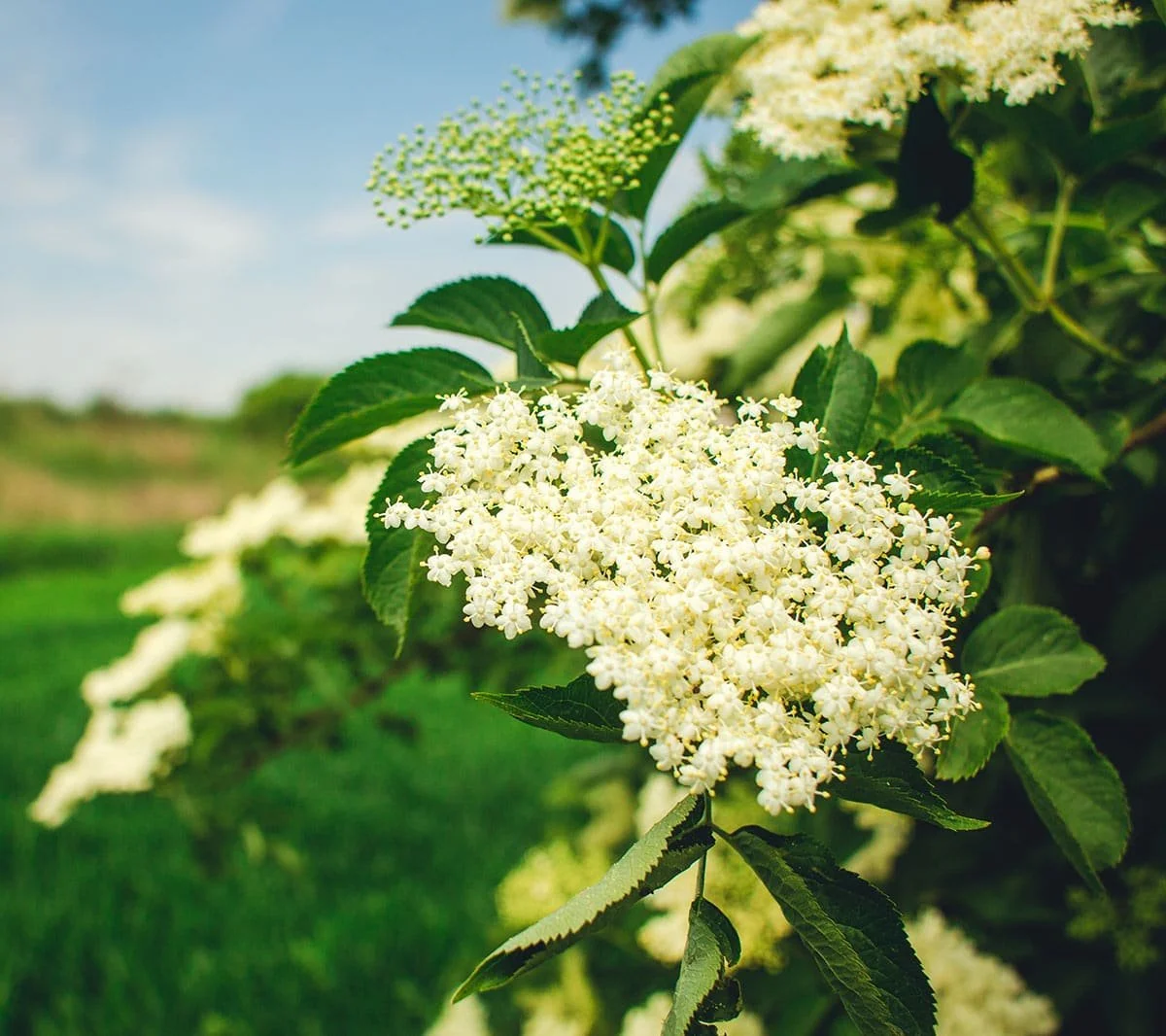
Elderflower arrives quietly but decisively. In late spring and early summer, the elder tree shifts from leaf to bloom, covering itself in wide, flattened clusters of tiny cream-coloured flowers. These umbels hover lightly at the ends of branches, their scent drifting long before the flowers are noticed visually.
Each flower is small and delicate, with five pale petals and prominent yellow stamens. Individually they are modest, but together they create a soft, luminous presence that feels almost suspended in the air. The flowers are fragile and short-lived, browning quickly once past their peak, which has always shaped how and when they are gathered.
Elderflower typically appears as:
Large, flat-topped clusters of many small flowers
Creamy white to pale yellow petals
Distinct sweet, musky-floral scent
Soft yellow pollen dusting the flowers
Brief flowering window in late spring to early summer
It is most commonly confused with:
Cow parsley, which flowers earlier and lacks scent
Hemlock or hogweed relatives, which have different leaf structure and toxic associations
Correct identification is essential, particularly when foraging from hedgerows where multiple white-flowered plants coexist.
Habitat, Growth & Ecology
Elder is native to the UK and widely distributed across hedgerows, woodland edges, waste ground and riverbanks. It thrives in nutrient-rich soils and disturbed ground, often appearing where human and ecological activity overlap.
Ecologically, elder plays a significant role throughout the year. Its flowers provide nectar for insects, its berries feed birds later in the season, and its hollow stems offer habitat for insects. Elder is a classic edge species, flourishing in transitional spaces rather than deep woodland or open field.
When harvesting elderflower, care is essential. Flowers should be taken sparingly from healthy trees, leaving plenty to develop into berries later in the season.
History, Tradition & Cultural Use
Elderflower has long been a cornerstone of European folk herbalism, woven into domestic life rather than specialist medicine. It was used seasonally, often as part of spring and early summer routines, supporting the body as it shifted out of winter stagnation.
Historically, elderflower appeared in teas, cordials, wines and washes. It was valued for its gentle, opening quality - a plant that encouraged movement through the body without force. Elderflower was often taken during times of heaviness, congestion or transition, particularly when the body needed encouragement rather than stimulation.
Its use was rarely isolated. Elderflower was commonly combined with other herbs, reflecting its role as a harmoniser rather than a dominant intervention.
Myth, Lore & Symbolism
Elder holds a unique place in European folklore, often regarded as a threshold tree. It was associated with boundaries between worlds, seasons and states of being. Respect for the elder tree was widespread, with traditions advising against cutting it unnecessarily or bringing its wood indoors.
Elderflower, in particular, became associated with renewal and passage. Its emergence marked a turning point in the year, a soft opening before the intensity of summer. In domestic tradition, elderflower preparations were seen as cleansing and protective, helping people move smoothly through seasonal change.
These symbolic meanings arose from long familiarity rather than dramatic myth - elder was watched, returned to and respected.
Areas of Scientific Research Interest
Modern scientific interest in elderflower has focused on its flavonoid content, antioxidant activity and interaction with inflammatory and respiratory pathways. Research often examines elderflower alongside elder berries, though the two have distinct properties and uses.
Elderflower extracts are used in modern herbal and cosmetic products, reflecting continuity between traditional use and contemporary application. Much research focuses on laboratory and preclinical models, with fewer human studies specific to elderflower alone.
Anti-inflammatory and Antioxidant Research
Studies suggest elderflower contains compounds that:
Support antioxidant activity
Interact with inflammatory signalling pathways
Contribute to tissue resilience
These findings help explain its traditional use in situations involving congestion, irritation or stagnation.
Respiratory and Diaphoretic Research
Elderflower has been studied for its role in supporting gentle sweating and respiratory comfort. Research explores how its compounds may influence circulation and fluid movement, aligning with its traditional classification as an opening, dispersing herb.
Nutritional Profile: Vitamins & Minerals
Elderflower is not used for nutrition in the conventional sense, but it contains supportive compounds that contribute to its traditional role.
Reported constituents include:
Vitamin C - supports immune function and connective tissue repair
Flavonoids - plant compounds associated with antioxidant activity and vascular support
Phenolic acids - contribute to cellular protection and inflammatory balance
Volatile oils - support aroma, sensory effects and traditional respiratory use
Its value lies more in functional chemistry than caloric or mineral density.
Traditional Use vs Modern Research
Traditional use of elderflower was guided by observation rather than theory. People noted that it encouraged movement - through the skin, the chest, the lymphatic system. It was used gently, often at the beginning of imbalance, before heaviness became entrenched.
Modern research reframes this through biochemical pathways, examining antioxidant and anti-inflammatory effects. While this offers useful explanation, it risks flattening elderflower into isolated actions rather than recognising its role as a seasonal facilitator of change.
Where the two frameworks align is in emphasis on gentleness and timing. Elderflower works best when used early, lightly and consistently. Where they diverge is in context: traditional use was seasonal and relational, while research often examines static extracts removed from their original timing.
Understanding elderflower requires keeping its seasonal role intact.
Preparation & Practical Use
Elderflower has always been prepared with care and immediacy. Its aroma fades quickly, and its flowers lose vitality if mishandled. Traditional preparation methods therefore emphasised freshness, light heat and short extraction times.
Flowers were gathered on dry days, used immediately or dried carefully for later use. Preparations focused on capturing scent and subtle action rather than strength.
Teas & Infusions
Common preparations include:
Light infusions made from fresh or dried flowers
Gentle teas taken regularly over short periods
These preparations are floral, soft and mildly sweet.
Cordials, Syrups & Preserves
Elderflower is also commonly prepared as:
Cordials and syrups
Lightly fermented drinks
Infused honeys
These forms extend its seasonal availability while preserving aroma.
Ethical Harvesting & Stewardship
Elderflower harvesting directly affects berry production later in the year, which is vital for wildlife.
Responsible practice includes:
Harvesting only a small portion of flowers from each tree
Leaving enough blooms to develop into berries
Avoiding trees growing near polluted areas
Harvesting on dry days to reduce spoilage
Elder demands reciprocity. Taking flowers without regard for the rest of the cycle breaks the relationship.
Safety & Considerations
Elderflower is generally safe when prepared correctly.
Considerations include:
Only flowers should be used, not stems or leaves
Over-strong preparations may cause digestive discomfort
Elderflower should not be confused with toxic lookalikes
Traditional use emphasised light, short-term use rather than intensity.
How We Work With Elderflower at KindRoots
At KindRoots, elderflower is treated as a plant of transition and balance. We work with it when gentle opening and movement are needed, particularly during seasonal shifts.
Elderflower is most often used in teas and cordials, either alone or blended with complementary herbs. It may also appear in respiratory or immune-supporting blends, chosen for its ability to soften and harmonise rather than dominate.
Our approach prioritises freshness, careful drying and light preparation. Elderflower is valued for how it supports the body’s own processes, not for forceful action.
Elderflower is used seasonally in our own practice and appears in a number of our preparations.
Closing Note
Elderflower teaches us that change does not always arrive through disruption. Sometimes it comes through soft opening, through encouragement rather than insistence.
To work with elderflower is to pay attention to timing - to recognise when the body is ready to move and to support that movement gently. It reminds us that transition, when respected, can be smooth, and that the most effective support often feels almost invisible as it does its work.
