
Spruce Tips ‘Picea spp’
Identification & Appearance
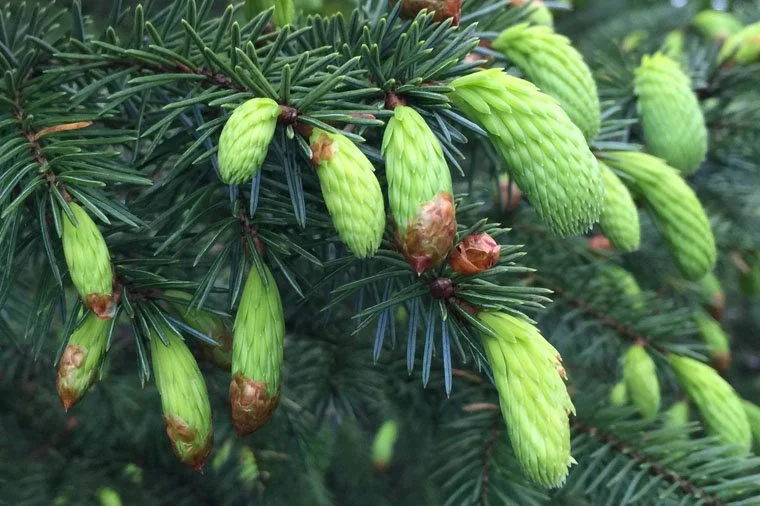
Spruce tips are the tender new growth that appears at the ends of spruce branches in spring. They emerge suddenly after winter, bright and unmistakable, marking a clear seasonal shift in the forest. Soft, pale green and almost luminous against the darker mature needles, spruce tips signal renewal long before warmth fully arrives.
When young, the tips are flexible and delicate, their needles short, soft and slightly translucent. They are often coated in a fine resin that releases a sharp, citrusy forest aroma when handled. This fleeting tenderness lasts only a short time before the needles harden and darken, becoming the familiar sharp, evergreen foliage of the mature tree.
Spruce tips typically appear as:
Bright green new growth at branch ends
Soft, flexible needles that do not yet prick
Conical or flame-shaped clusters
Strong resinous, citrus-like scent
Brief seasonal presence in spring
They are most commonly confused with:
Fir tips, which have flatter needles
Pine tips, which grow as bundles rather than singly
Correct tree identification is essential before harvesting.
Habitat, Growth & Ecology
Several spruce species are present in the UK, though most are not native. Norway spruce, for example, has been widely planted for forestry, while Sitka spruce dominates commercial plantations. Despite their non-native status, spruce trees have become ecologically embedded in many UK landscapes.
Spruce thrives in cool, moist conditions and plays a significant role in upland and managed woodland ecosystems. The emergence of spring tips represents a period of intense growth, drawing heavily on the tree’s stored energy after winter dormancy.
Ethical harvesting of spruce tips is essential. Removing too many tips can disrupt a tree’s growth pattern. Only small amounts should be taken from any one tree, and never from young or stressed specimens.
History, Tradition & Cultural Use
Spruce tips have been used traditionally across northern and alpine regions where evergreen forests dominate. Their use was shaped by seasonality and scarcity rather than abundance. When fresh greens were limited after winter, spruce tips provided both nourishment and flavour.
Historically, spruce tips were prepared as teas, syrups and fermented drinks. They were valued for their freshness and vitality rather than potency. In some cultures, they were added to broths or preserved in honey or sugar, creating tonics that carried the scent of the forest into darker months.
Spruce tips belonged to spring rituals of renewal. They were gathered carefully, used briefly, and appreciated for their timing rather than longevity.
Myth, Lore & Symbolism
Evergreens have long symbolised endurance and continuity, and spruce tips represent the moment when that endurance turns toward growth. In folk tradition, bringing evergreen boughs into the home during winter was believed to offer protection and remind inhabitants of life continuing beneath the cold.
Spruce tips, appearing at the threshold between winter and spring, carried symbolic weight as messengers of return. They were associated with resilience, freshness and the promise of renewal after hardship. These meanings arose from lived seasonal experience rather than formal mythology.
Areas of Scientific Research Interest
Modern scientific interest in spruce tips has focused primarily on their nutritional content and aromatic compounds. Research has examined their vitamin levels, antioxidant capacity and resinous chemistry, particularly in relation to respiratory and immune contexts.
Spruce-derived compounds are also used in modern flavouring and fragrance industries, representing a continuation of traditional sensory use in contemporary forms.
Vitamin C and Antioxidant Research
Studies suggest spruce tips contain significant levels of vitamin C and antioxidant compounds, particularly when fresh. Research highlights their role in supporting immune resilience and protecting cells from oxidative stress.
These findings align with traditional spring use, when spruce tips were gathered to replenish the body after winter depletion.
Aromatic and Resin Research
Spruce resins and volatile compounds have been studied for their interaction with respiratory pathways and microbial environments at a laboratory level. This research helps explain traditional use in teas and inhalations, though it does not imply medical treatment.
Nutritional Profile: Vitamins & Minerals
Spruce tips are nutritionally notable compared to many wild greens, particularly when freshly harvested.
Reported constituents include:
Vitamin C - supports immune function, collagen formation and cellular repair
Vitamin A (carotenoids) - supports skin health, vision and mucous membrane integrity
Chlorophyll - supports cellular health and detoxification pathways
Polyphenols - plant compounds associated with antioxidant activity
Volatile oils and resins - contribute to aroma, respiratory sensation and antimicrobial interaction
Their nutritional value is highest when used fresh or gently prepared.
Traditional Use vs Modern Research
Traditional use of spruce tips focused on timing and replenishment rather than intervention. They were gathered briefly, used sparingly, and relied upon to bring freshness back into the body after winter. Effects were understood through seasonal renewal rather than targeted outcomes.
Modern research reframes this through nutritional and biochemical lenses, measuring vitamin content and antioxidant capacity. While this provides useful explanation, it can overlook the importance of seasonality and context that shaped traditional use.
Where both frameworks align is in recognising spruce tips as restorative rather than aggressive. Where they diverge is in scale: traditional use was brief and seasonal, while modern products often aim for year-round availability.
Understanding spruce tips requires respecting both their chemistry and their timing.
Preparation & Practical Use
Spruce tips have always been prepared in ways that preserve their freshness and aroma. Their volatile compounds are easily lost through prolonged heat, shaping preparation methods that emphasise light handling and gentle extraction.
Because spruce tips are available for only a short period each year, many preparations focus on capturing their character for later use while respecting their delicate chemistry.
Teas & Infusions
Common preparations include:
Light teas made with fresh tips
Short infusions that preserve aroma and vitamin content
These preparations are bright, citrusy and gently resinous.
Syrups, Honeys & Preserves
Spruce tips are often preserved as:
Syrups cooked slowly with sugar
Infused honeys
Fermented beverages
These methods allow spruce tips to be enjoyed beyond their brief harvest window.
Ethical Harvesting & Stewardship
Spruce tips are a vulnerable growth stage of the tree. Overharvesting can permanently affect form and health.
Responsible practice includes:
Taking only a few tips from each tree
Never harvesting from young or stressed trees
Avoiding repeated harvesting from the same individuals year after year
Harvesting only during the brief window when tips are soft
Stewardship is especially important due to the short seasonal availability.
Safety & Considerations
Spruce tips are generally safe when correctly identified and prepared.
Considerations include:
Accurate tree identification is essential
Resinous compounds may irritate sensitive digestion if overused
Best used fresh or lightly prepared rather than concentrated
Moderation and timing are key.
How We Work With Spruce Tips at KindRoots
At KindRoots, spruce tips are treated as a seasonal gift rather than a year-round staple. We work with them when they are fresh, vibrant and most alive.
Spruce tips are most often used in teas, syrups and flavour-forward preparations, where their bright, forest citrus character brings freshness and lift. They may also appear in respiratory-supporting blends, chosen as much for flavour and aroma as for tradition.
Our approach prioritises careful harvesting, small quantities and gentle preparation. Spruce tips are valued for what they offer in a short window, not for how much can be extracted from them.
Spruce tips are gathered and used seasonally in our own practice and appear in a small number of our preparations.
Closing Note
Spruce tips arrive with urgency. They appear, soften, harden and pass, reminding us that not all nourishment is meant to last. Their value lies in attention - in noticing the moment when the forest shifts and responding while it is still tender.
To work with spruce tips is to accept seasonality as part of care. They offer renewal not through force, but through timing, teaching us that restoration often begins quietly, at the edge of change, long before comfort fully returns.
