
Wild Garlic ‘Allium ursinum’
Identification & Appearance
Wild garlic announces itself before it is seen. In early spring, woodland floors fill with a strong, unmistakable garlic scent that seems to rise directly from the soil. This aroma is often the first sign of its presence, drifting through damp woods and shaded paths long before flowers appear.
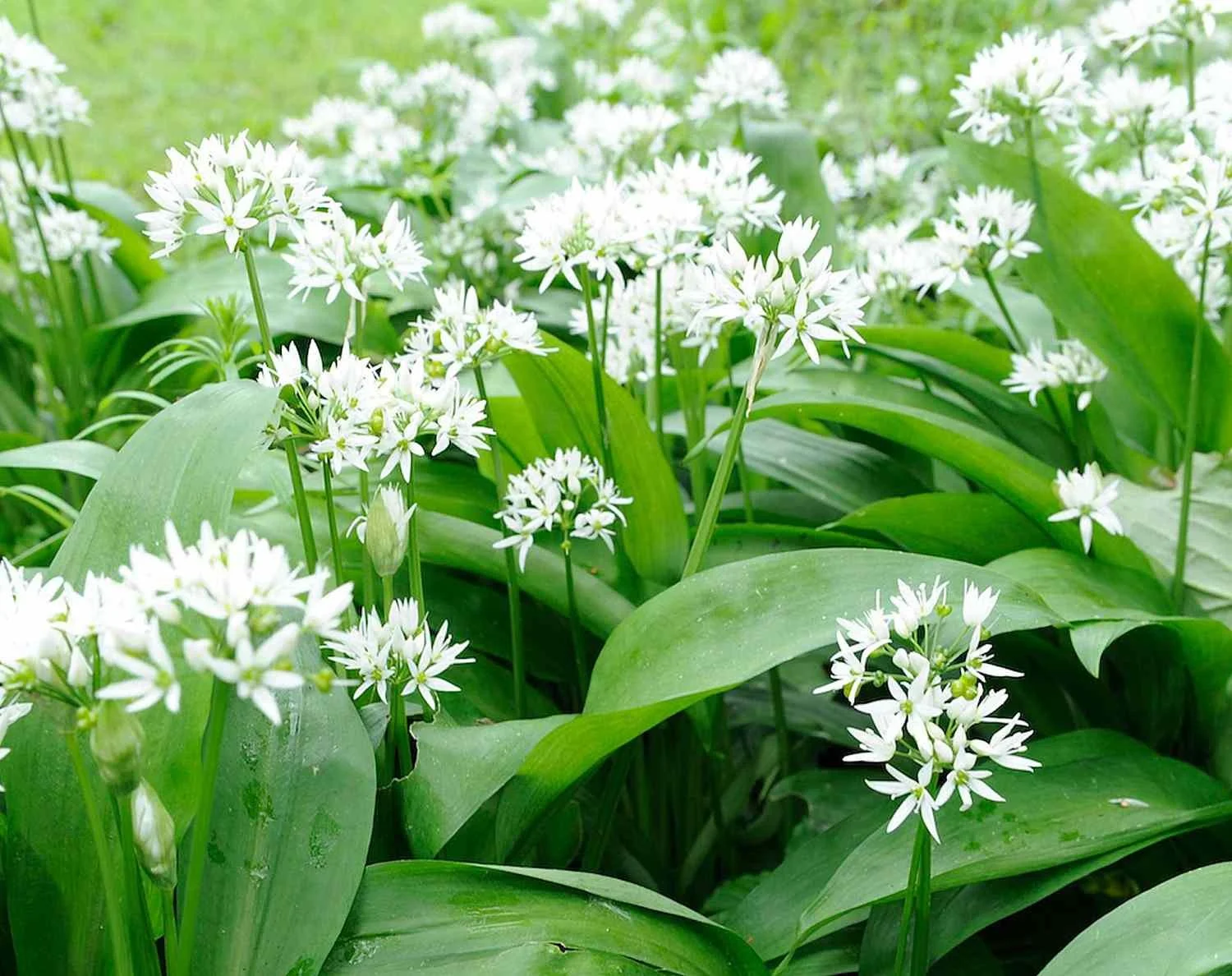
The plant forms broad, lance-shaped leaves that emerge directly from the ground, soft and vivid green, each leaf narrowing toward the base. As the season progresses, slender stalks rise above the leaves, topped with loose clusters of small white, star-shaped flowers. These blooms feel light and open, contrasting with the plant’s powerful scent and flavour.
Wild garlic grows in dense carpets, transforming woodland floors into bright green expanses during its short season. It is generous but fleeting, disappearing almost entirely by early summer.
Wild garlic typically appears as:
Broad, smooth, lance-shaped green leaves
Strong garlic aroma when crushed
White star-shaped flowers in loose clusters
Hollow, triangular flowering stems
Dense seasonal growth forming carpets
It is most commonly confused with:
Lily of the valley
Autumn crocus
Lords-and-ladies
Crushing a leaf to confirm the garlic scent is essential for safe identification.
Habitat, Growth & Ecology
Wild garlic is native to the UK and widespread across Europe. It thrives in damp, shaded woodlands, riverbanks and hedge bottoms, favouring rich soils with consistent moisture.
Ecologically, wild garlic plays a seasonal role in woodland systems. Its early growth provides ground cover before trees fully leaf out, helping suppress competing species and stabilise soil. When it dies back, nutrients are returned to the forest floor, supporting the next phase of growth.
Wild garlic’s abundance is cyclical rather than constant. Its presence marks a brief window of intense vitality followed by complete withdrawal.
History, Tradition & Cultural Use
Wild garlic has long been used as a seasonal food and medicinal plant across Europe. Historically, it was gathered as one of the first fresh greens after winter, valued for its pungency and perceived cleansing qualities.
It appeared in folk traditions as a spring tonic, used to wake the body after colder months of preserved food and reduced movement. Leaves were eaten fresh, added to soups, or infused into simple preparations, while flowers were sometimes used more lightly for flavour and decoration.
Wild garlic was not a plant of subtlety. Its role was to stimulate, clear and reintroduce freshness after dormancy.
Myth, Lore & Symbolism
Wild garlic has long been associated with renewal and transition. Its emergence marked the turning point between winter scarcity and spring abundance, making it symbolically linked to cleansing and forward movement.
In folk tradition, it was believed that bears sought out wild garlic upon waking from hibernation, reinforcing its reputation as a plant of awakening and strength. Whether literal or symbolic, this association reflects how people understood its role in seasonal recovery.
Areas of Scientific Research Interest
Modern research into wild garlic has focused on its sulfur-containing compounds and their interaction with cardiovascular, antimicrobial and metabolic pathways. Much of this research builds upon knowledge derived from cultivated garlic, though wild garlic has a distinct chemical profile.
Wild garlic extracts and preparations are increasingly studied for their potential functional effects rather than as pharmaceutical agents.
Cardiovascular and Circulatory Research
Studies suggest compounds in wild garlic may:
Support normal blood vessel function
Influence lipid metabolism
Contribute to circulatory balance
These findings align with traditional use as a spring cleanser rather than a targeted treatment.
Antimicrobial Research
Laboratory studies have examined wild garlic’s antimicrobial activity, particularly against certain bacteria and fungi. These studies help explain its historical use in food preservation and topical applications, though they do not imply standalone medical use.
Nutritional Profile: Vitamins & Minerals
Wild garlic is nutritionally active, particularly when consumed fresh.
Reported constituents include:
Vitamin C - supports immune function and connective tissue health
Vitamin A (carotenoids) - supports vision, skin and mucous membranes
Iron - supports oxygen transport and energy production
Calcium - supports bone health and muscle function
Sulfur compounds (allicin-related) - associated with cardiovascular and antimicrobial research
Chlorophyll - supports detoxification pathways and cellular health
Its nutritional contribution is most significant when used fresh and seasonally.
Traditional Use vs Modern Research
Traditional use of wild garlic was shaped by timing and abundance. It was eaten when it appeared and stopped when it vanished. People did not consume it year-round, nor did they isolate its effects. They observed that it sharpened appetite, cleared heaviness and reintroduced vitality after winter.
Modern research isolates sulfur compounds and examines specific biological interactions. While this offers useful insight, it risks flattening wild garlic into a list of properties rather than a seasonal relationship.
Where the two frameworks align is in recognising wild garlic as activating and supportive rather than calming or building. Where they differ is in scale and continuity. Wild garlic was never intended for constant use.
Preparation & Practical Use
Wild garlic has always been prepared in ways that preserve freshness and volatility. Its potency lies in raw or lightly processed forms rather than extended extraction.
Historically, preparation emphasised immediacy, simplicity and seasonality.
Culinary and Fresh Use
Common traditional uses include:
Fresh leaves chopped into foods
Light pestos and sauces
Soups added near the end of cooking
These preparations retain flavour and nutritional value.
Infusions and External Use
Wild garlic has also been used in:
Light infusions
Simple washes
These uses were secondary to food-based application.
Ethical Harvesting & Stewardship
Wild garlic grows abundantly, but careless harvesting can damage woodland ecosystems.
Responsible practice includes:
Harvesting leaves rather than bulbs
Taking small amounts from large patches
Avoiding trampling sensitive woodland floors
Leaving flowers intact to support reproduction
Harvesting away from polluted areas
Bulbs should never be removed, as this permanently damages colonies.
Safety & Considerations
Wild garlic is generally safe when correctly identified.
Considerations include:
Absolute certainty in identification to avoid toxic lookalikes
Moderation, particularly when eaten raw
Awareness that strong sulfur compounds may irritate sensitive digestion
Traditional use relied on seasonal moderation and familiarity.
How We Work With Wild Garlic at KindRoots
At KindRoots, wild garlic is treated as a seasonal gift rather than a staple.
We work with wild garlic primarily as a fresh food ingredient and occasionally in light infusions or preserved preparations such as oils or salts. It is valued for its ability to bring brightness, movement and flavour after winter, rather than for long-term use.
Our approach emphasises respectful harvesting, minimal processing and clear seasonal boundaries, allowing wild garlic to remain what it has always been: brief, potent and deeply tied to spring.
Wild garlic is used seasonally in our own practice and appears in a small number of our preparations.
Closing Note
Wild garlic reminds us that not all nourishment is meant to last. Some plants arrive loudly, change everything, and then disappear completely.
To work with wild garlic is to pay attention to timing. It teaches that renewal comes in bursts, not constants, and that vitality is sometimes found not in accumulation, but in knowing when something has finished its work and is ready to return to the soil.
