
Fireweed Rosebay Willowherb ‘Chamerion angustifolium’
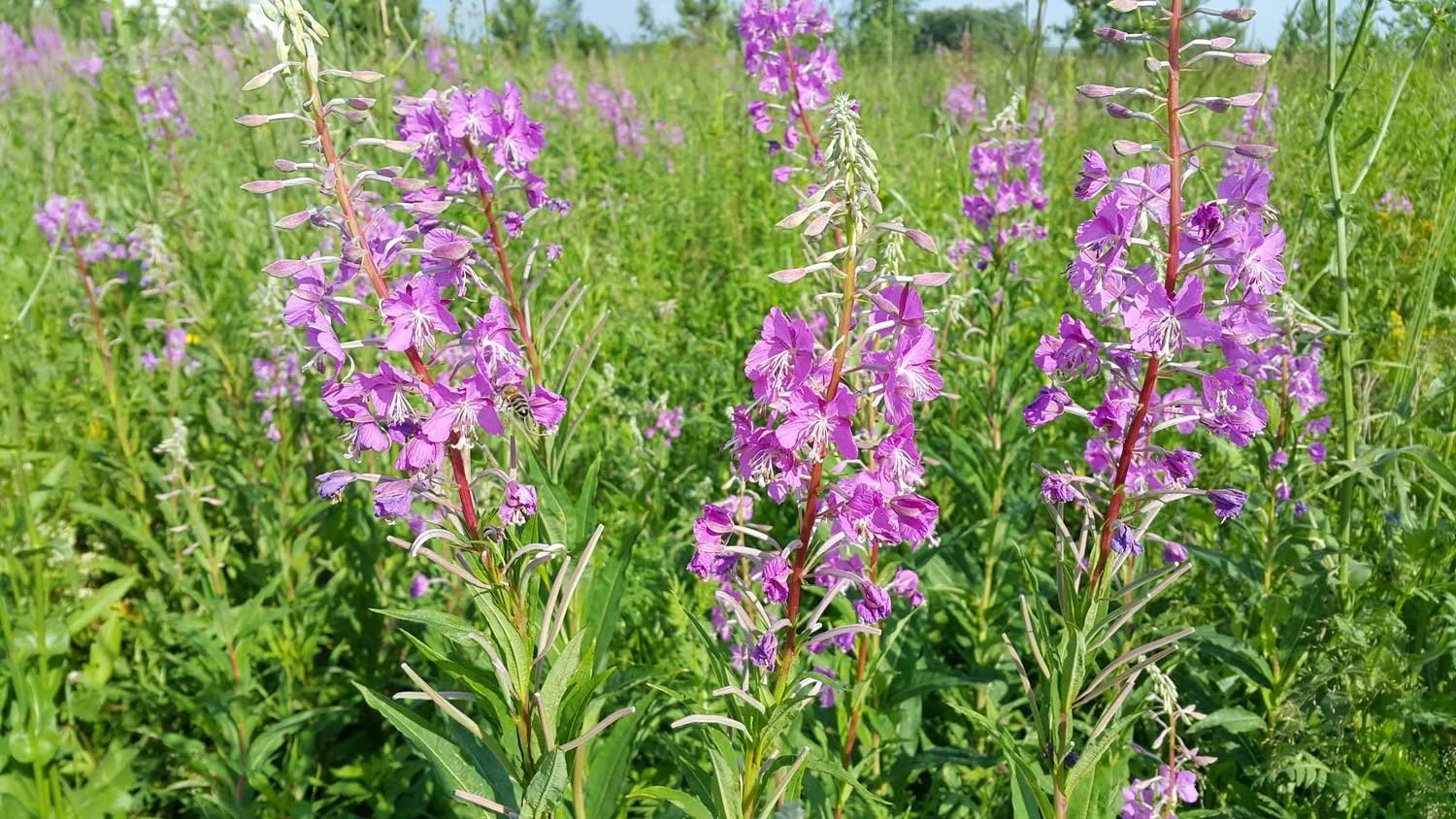
Identification & Appearance
Fireweed is a plant of aftermath and recovery. Tall, upright and vivid, it appears most dramatically where the land has been disturbed, rising quickly from cleared ground, burns and broken soil. Its presence feels decisive, almost architectural, as if it is stitching landscapes back together.
The plant grows on a single central stem that can reach over a metre tall, lined with narrow, lance-shaped leaves arranged alternately. In summer, long spires of magenta-pink flowers open gradually from the bottom upward, extending the flowering season over many weeks. As the blooms fade, they are replaced by slender seed pods that eventually split open to release clouds of fine white fluff, carrying seeds far on the wind.
Fireweed typically appears as:
Tall, upright stems with alternating narrow leaves
Long flowering spikes of bright pink-purple flowers
Flowers opening sequentially from bottom to top
Slender seed pods that release cotton-like fluff
Strong vertical presence in open landscapes
It is most commonly confused with:
Other willowherbs, which are generally smaller and less vivid
Garden ornamentals with similar colour but different leaf arrangement
Height, growth habit and flower structure are key identifiers.
Habitat, Growth & Ecology
Fireweed is native to the UK and much of the northern hemisphere, but it behaves aggressively in disturbed environments. It thrives on cleared land, roadside verges, railway cuttings, woodland edges and post-fire landscapes, giving rise to its common name.
In the UK, fireweed is often described as invasive, not because it is non-native, but because of how rapidly it colonises open ground. Its seeds travel easily, and its underground rhizomes allow it to establish dense stands quickly.
Ecologically, fireweed plays a transitional role. It stabilises soil, shades bare ground and prepares the way for longer-term vegetation. Over time, as trees and shrubs return, fireweed naturally recedes. Its abundance is therefore temporary, tied to disruption rather than permanence.
History, Tradition & Cultural Use
Fireweed has a long history of use across northern Europe, Russia and Indigenous cultures of North America. It was valued as both food and medicine, particularly in landscapes shaped by cold climates and seasonal scarcity.
Leaves were traditionally fermented to make Ivan Chai, a caffeine-free tea that became widely used in Russia and Eastern Europe. Young shoots were eaten as a spring vegetable, and flowers were used more sparingly for flavour and colour.
Fireweed was not treated as a luxury plant. It was valued for its abundance, reliability and adaptability, especially in places where cultivated crops were limited or disrupted.
Myth, Lore & Symbolism
Fireweed is deeply symbolic of regeneration. Its ability to appear after fire, war and destruction has linked it with resilience, continuity and quiet strength. In many cultures, its presence was seen as reassurance that the land was healing, even if it did not yet look fertile.
The plant carries an implicit message: recovery does not require perfection. It begins wherever there is space.
Areas of Scientific Research Interest
Modern scientific interest in fireweed has focused on its polyphenol content, antioxidant activity and interaction with inflammatory and hormonal pathways. Research often examines extracts of leaves and flowers, particularly in relation to prostate and urinary health.
Fireweed is increasingly included in modern herbal formulations, especially in Europe, reflecting continuity with traditional use.
Anti-inflammatory and Antioxidant Research
Studies suggest fireweed contains compounds that:
Contribute to antioxidant activity
Interact with inflammatory signalling pathways
Support cellular resilience under stress
These findings help explain its historical use for irritation and recovery.
Hormonal and Prostate Research
Some research has explored fireweed’s interaction with hormonal pathways, particularly enzymes involved in androgen metabolism. These studies are preliminary and largely preclinical, but they have informed modern interest in fireweed for prostate-related formulations.
Nutritional Profile: Vitamins & Minerals
Fireweed is nutritionally active, particularly when used as a tea or fermented leaf.
Reported constituents include:
Vitamin C - supports immune function and connective tissue health
Vitamin A (carotenoids) - supports skin and mucous membranes
Iron - supports oxygen transport and energy production
Calcium - supports bone health and cellular signalling
Magnesium - supports muscle function and nervous system regulation
Polyphenols - contribute to antioxidant and inflammatory research interest
Mucilage - supports soothing interaction with mucous membranes
Its nutritional and functional value overlaps, particularly in whole-leaf preparations.
Traditional Use vs Modern Research
Traditional use of fireweed was broad and adaptive. It was used as food, tea and medicine without rigid distinction, shaped by what the plant offered at different stages of growth. Effects were understood through seasonal experience rather than isolated outcomes.
Modern research narrows this focus, isolating compounds and examining specific pathways. While this offers useful insight, it risks separating fireweed from its ecological and cultural context.
Where both frameworks align is in recognising fireweed as supportive rather than forceful. Where they differ is in intention. Traditional use prioritised nourishment and resilience; modern research often seeks targeted effects.
Understanding fireweed requires holding both views without collapsing one into the other.
Preparation & Practical Use
Fireweed has always been prepared with respect for its stage of growth. Different parts were used at different times, shaping preparation methods that changed across the season.
Preparation emphasised transformation rather than concentration.
Teas and Fermentation
Traditional preparations include:
Fresh or dried leaf teas
Fermented leaf teas (Ivan Chai), where leaves are bruised and oxidised before drying
Fermentation alters flavour and chemistry, producing a smooth, dark tea with reduced bitterness.
Culinary and Light Use
Young shoots were historically eaten as a spring vegetable, while flowers were used sparingly for colour and mild sweetness.
Ethical Harvesting & Stewardship
Fireweed is abundant, but ethical harvesting still matters.
Responsible practice includes:
Harvesting leaves rather than uprooting plants
Taking small amounts from large stands
Avoiding harvesting in polluted or recently treated areas
Leaving flowering material for pollinators
Because fireweed often occupies recovering landscapes, care should be taken not to interfere with natural succession.
Safety & Considerations
Fireweed is generally well tolerated when used appropriately.
Considerations include:
Moderation in long-term use
Awareness that hormonal research is preliminary
Proper identification to avoid confusion with other willowherbs
Traditional use relied on variety and seasonality rather than constant intake.
How We Work With Fireweed at KindRoots
At KindRoots, fireweed is treated as a plant of transition and resilience.
We work with fireweed primarily as a fermented or dried leaf tea, valuing its smooth flavour and grounding character. It may also appear in blends where gentle antioxidant and soothing qualities are appropriate.
Our approach emphasises seasonal harvesting, minimal intervention and respect for fireweed’s ecological role, allowing it to remain what it has always been: a marker of recovery rather than a permanent fixture.
Fireweed is used simply and with familiarity in our own practice and appears in a limited number of our preparations.
Closing Note
Fireweed grows where something has ended. It does not apologise for taking space, nor does it intend to stay forever.
To work with fireweed is to recognise that healing often begins in disturbed ground. It reminds us that recovery is not the return to what was before, but the emergence of something capable of holding what comes next.
