
Turkey Tail ‘Trametes versicolor’
Identification & Appearance
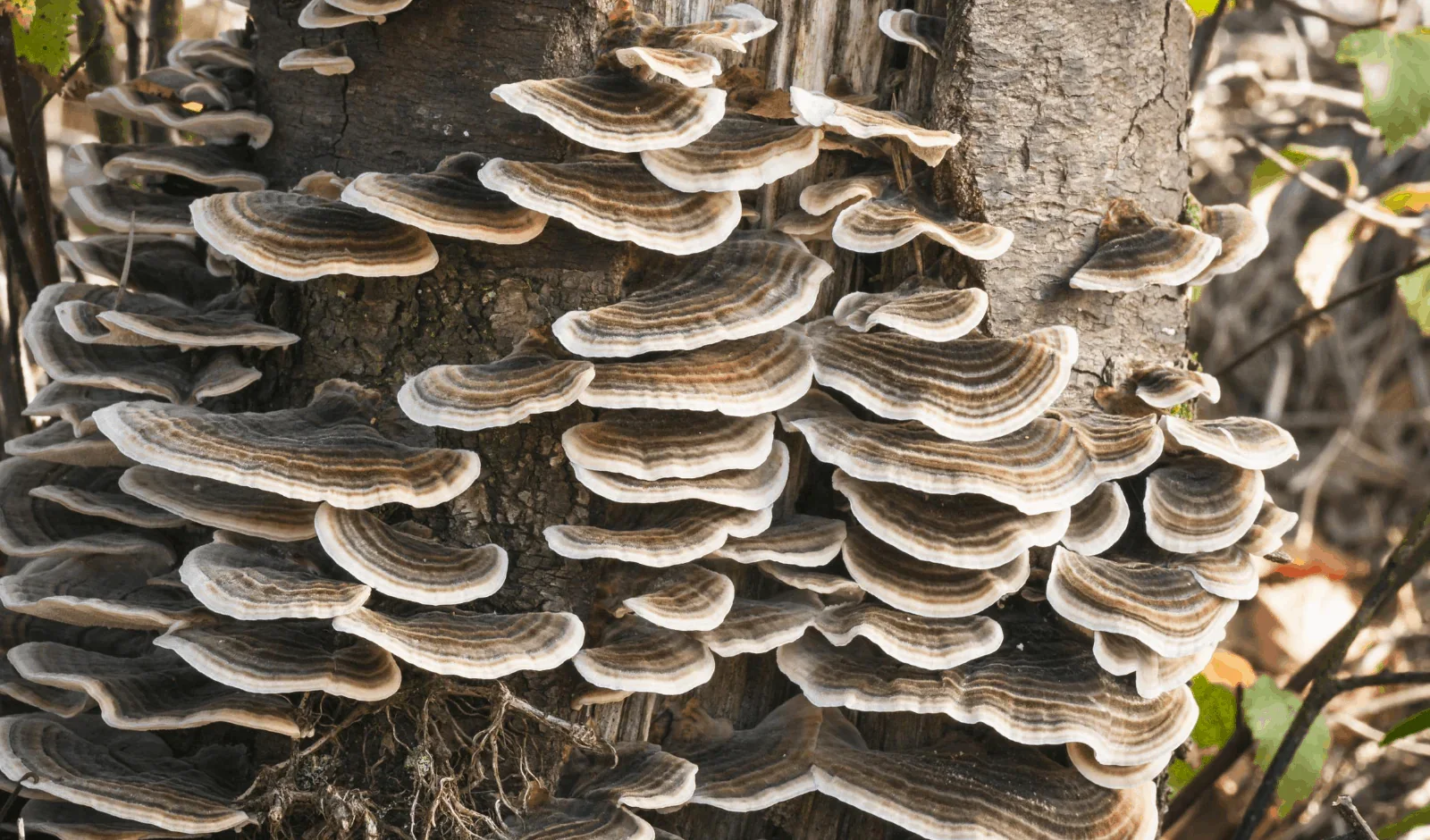
Turkey Tail is one of the most common and recognisable bracket fungi in British woodlands, but it rarely feels ordinary when you actually stop and look at it. It grows in layered shelves across dead wood, forming overlapping fans with concentric bands of colour that can look painted on - creams, tans, browns, greys, and sometimes subtle hints of blue or green from surface algae. The effect is feathered and patterned, like the layered tail of a turkey, which is how it earned its name.
Unlike mushrooms that appear briefly and vanish, Turkey Tail is built for persistence. Its fruiting bodies are thin, leathery, and tough, often surviving through winter, fading and re-colonising in place. The upper surface is usually velvety or finely hairy, especially when young. The underside is where true identification is confirmed: Turkey Tail is a pore fungus. Its underside is pale and covered in very fine, evenly spaced pores - never gills, never smooth.
Once familiar, it is easy to spot, but careful identification remains essential because lookalikes are common and some are not appropriate for use.
Turkey Tail typically appears as:
Thin, fan-shaped brackets growing in overlapping shelves or rosettes
Concentric bands of multiple colours across the top surface
Velvety or finely hairy texture on the upper surface
Pale underside with very fine, regular pores
Tough, leathery texture rather than fleshy softness
It is most commonly confused with:
False Turkey Tail (Stereum species), which has a smooth underside with no pores
Other Trametes species with less regular pore structure
Thin bracket fungi that resemble Turkey Tail from above but differ underneath
The underside pore layer is the most reliable identification feature.
Habitat, Growth & Ecology
Turkey Tail is native to the UK and extremely widespread across Europe and much of the world. It is a saprophytic fungus, meaning it grows on dead and decaying wood rather than living trees. It prefers hardwoods such as oak, beech and birch, but can occasionally occur on softwood depending on region and conditions.
Ecologically, Turkey Tail is a powerful decomposer. It breaks down lignin and cellulose, turning fallen timber back into soil and returning locked nutrients to woodland systems. Its ability to persist through cold weather reflects its role as a long-term recycler rather than a short-lived fruiting mushroom.
Turkey Tail often grows in large, dense patches on the same log, which makes it feel abundant. That abundance is real, but it should not be treated as limitless. Its presence is part of a larger decomposition community, and harvesting should respect that role.
History, Tradition & Cultural Use
Turkey Tail has a long and well-documented history across several traditional systems. In East Asia, it is most famously associated with Chinese and Japanese medicinal practice, where it was prepared as a decoction or extract and used consistently over time rather than as a short-term remedy.
In many Indigenous North American traditions, bracket fungi including Turkey Tail were also used in practical and seasonal ways, often in relation to endurance and recovery. In Europe, Turkey Tail was historically less central than some other fungi, but it still appeared in folk contexts where accessible woodland fungi were used as part of broader winter practice.
What stands out in Turkey Tail’s traditional history is the emphasis on regularity. It was not treated as rare or dramatic. It was used because it was available, resilient, and could be incorporated into long routines.
Myth, Lore & Symbolism
Turkey Tail’s symbolism is rooted in pattern, repetition and diversity. Its concentric bands have long been read as a visual reminder that strength can be layered, built gradually through cycles rather than created in a single moment.
Because it grows in shelves across dead wood, Turkey Tail is often associated with renewal and transformation - life continuing through decay, and resilience emerging from what has already fallen. In everyday seasonal tradition, bracket fungi like Turkey Tail became quiet symbols of winter survival: not delicate abundance, but steady persistence.
Its lore is less about heroic stories and more about lived observation. It is a fungus that returns, holds on, and keeps working long after other things have disappeared.
Areas of Scientific Research Interest
Turkey Tail is one of the most researched medicinal mushrooms in the world, largely because of its complex polysaccharides and polysaccharopeptides. Scientific interest has focused on how Turkey Tail interacts with immune signalling, gut ecology and cellular stress pathways. Research includes laboratory work, animal research, and a meaningful amount of human research, particularly in adjunct contexts.
Importantly, Turkey Tail has a unique position among medicinal mushrooms: specific extracts derived from it have been used in regulated clinical settings in some countries. This makes it one of the clearest examples where fungal research moved beyond theory into applied medicine.
Immune Modulation Research
Turkey Tail contains beta-glucans and polysaccharopeptides, most notably PSK (polysaccharide-K) and PSP. Research suggests these compounds may:
Support immune responsiveness and signalling rather than blunt stimulation
Influence communication between immune cells
Contribute to balanced immune activity over time
A significant portion of Turkey Tail research comes from Japan and China, where PSK and related extracts have been studied as adjuncts alongside conventional treatment in specific clinical contexts.
Clinical Use and Modern Medical Application
Turkey Tail-derived PSK has been used as an approved adjunct in oncology settings in Japan, integrated into clinical practice in certain contexts. This does not make Turkey Tail a treatment in itself, but it is a clear example of a mushroom compound being developed into a modern medical application.
This is one of the reasons Turkey Tail remains central in the global medicinal mushroom conversation: the research is not only theoretical, it has been applied.
Gut Microbiome and Prebiotic Research
More recent research has explored Turkey Tail as a functional prebiotic, meaning its polysaccharides may:
Support beneficial gut bacteria
Increase microbial diversity
Influence gut-immune communication
Human studies in this area suggest Turkey Tail can shift microbiome composition over time, which aligns with its traditional positioning as a long-term support rather than a quick fix.
Antioxidant and Cellular Stress Research
Turkey Tail has also been examined for antioxidant activity and interaction with cellular stress pathways. Studies suggest it contains compounds that:
Support antioxidant defence mechanisms
Influence oxidative stress markers in controlled settings
This research is often preclinical, but it provides plausible biological context for long-standing traditional use in endurance and recovery.
Nutritional Profile: Vitamins & Minerals
Turkey Tail is not used primarily for vitamins and minerals, but as a whole mushroom it does contain nutritionally relevant constituents alongside its research-active compounds.
Reported constituents include:
Beta-glucans - support immune modulation research and gut interaction
Polysaccharides - support microbiome and immune signalling research
Potassium (trace) - supports normal muscle and nerve function
Copper (trace) - supports connective tissue formation and iron metabolism
Selenium (trace, variable) - supports antioxidant enzyme activity
Fibre (structural) - supports digestive function and microbial activity
Turkey Tail’s primary value remains its polysaccharide profile rather than mineral density, but these constituents contribute to its whole-material character.
Traditional Use vs Modern Research
Traditional use of Turkey Tail consistently emphasised long-term, steady intake. It was prepared as a decoction or extract, taken daily or seasonally, and understood as something that supported resilience rather than something that delivered immediate effect.
Modern research aligns strongly with this structure. Many studies focus on immune markers, microbiome changes and systemic support that only become meaningful over time. Even where clinical research exists, it tends to appear in adjunct contexts, reinforcing the idea that Turkey Tail is not a dramatic standalone intervention but a supportive background presence.
Where the frameworks differ is in how they describe results. Traditional practice speaks in terms of endurance, recovery, balance and seasonal robustness. Modern science speaks in immune signalling pathways, polysaccharide fractions and microbiome shifts. They are different languages pointing toward a similar pattern: consistent use matters more than intensity.
Preparation & Practical Use
Turkey Tail is tough, leathery and structurally dense. This matters, because its most researched compounds are not easily accessed through quick brewing. Traditional use and modern research both point toward preparation methods that involve time.
Turkey Tail is best approached as a slow material. It rewards patience, and its usefulness is shaped by extraction method, quality of mushroom, and consistency of routine.
Decoctions
Decoction is the most traditional preparation.
Common practice involves:
Drying the fruiting bodies
Breaking or cutting into small pieces
Simmering gently for an extended period
Straining and reusing the same material multiple times
The resulting liquid is mild, earthy and generally less bitter than many medicinal fungi.
Tinctures and Dual Extracts
Turkey Tail is also commonly prepared as:
Hot water extracts to access polysaccharides
Dual extracts (water + alcohol) to broaden the compound spectrum
Extraction method and duration significantly affect the final profile, which is important when comparing home preparations to research materials.
Blended and Routine Use
Historically, Turkey Tail was often used:
As a daily decoction
As a base in mushroom blends
As part of seasonal routines rather than short-term use
Its role is often foundational rather than dramatic.
Ethical Harvesting & Stewardship
Turkey Tail is abundant in many woodlands, but ethical harvesting still matters because it is part of a decomposition community.
Responsible practice includes:
Harvesting only what you will use
Leaving plenty behind for ecological function and reproduction
Choosing clean environments away from roads and pollution
Cutting cleanly rather than tearing from wood
Avoiding heavily degraded logs where many fungi and insects are already relying on the same habitat
Abundance does not remove responsibility. It simply makes sustainable practice easier.
Safety & Considerations
Turkey Tail is generally well tolerated when correctly identified and properly prepared, but several considerations matter.
Key points include:
Correct identification is essential - pores on the underside are non-negotiable
Start with small amounts if new to medicinal mushrooms
Be aware of individual sensitivities, including digestive response
Consider medication interactions and clinical context if using alongside medical treatment
As with all fungi, quality, cleanliness of habitat and preparation method influence safety.
How We Work With Turkey Tail at KindRoots
At KindRoots, Turkey Tail is one of our core mushrooms because it is both accessible and deeply researched. We work with it as a steady, foundational ally rather than a novelty ingredient.
We most often use Turkey Tail in tinctures, dual extracts and long-decoction preparations, because these methods align most closely with both traditional use and the research landscape. It also appears in blends where immune resilience and gut support are the priority, working as a background structure that supports consistency over time.
Because Turkey Tail is abundant, it allows for reliable production without relying on slow-growing species. Even so, we harvest thoughtfully, choosing clean woodland environments and taking only what is needed. Our focus is on quality, preparation method and continuity - the same principles that made Turkey Tail valuable historically and that continue to shape modern research.
Turkey tail is used steadily and over time in our own practice, and appears in a small number of our preparations.
Closing Note
Turkey Tail is a reminder that common does not mean simple. It grows everywhere, yet its pattern holds complexity, its toughness holds persistence, and its usefulness unfolds slowly.
To work with Turkey Tail is to learn the value of steady background support. It teaches that resilience is often built through repetition: the same preparation made again, the same routine maintained through seasons, the same quiet relationship with something that does not need to be rare to be powerful.
