
Chaga ‘Inonotus obliquus’
Identification & Appearance
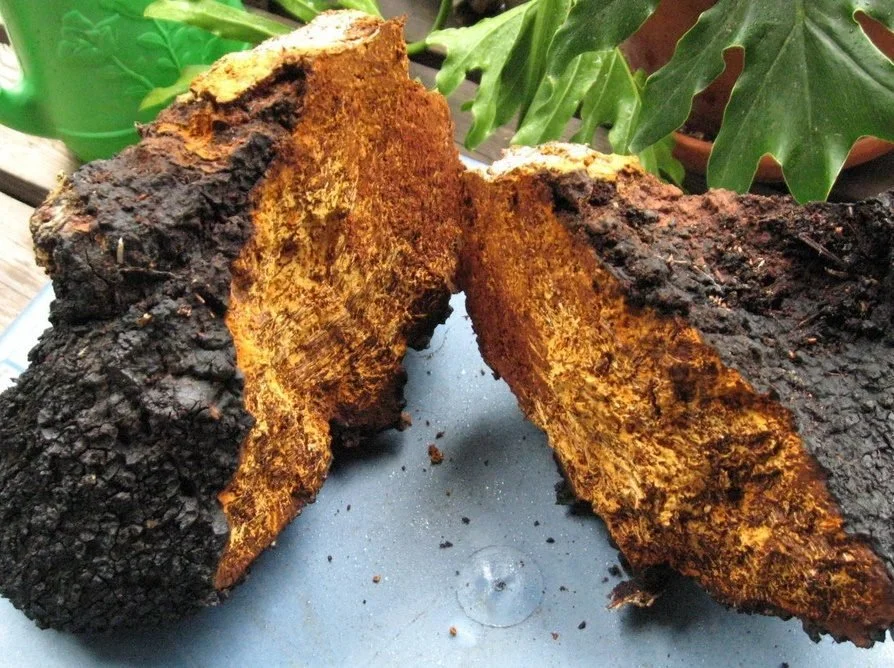
Chaga is one of the forest’s strangest offerings because it barely looks like a mushroom at all. Rather than forming a cap, gills or brackets, it appears as a dense, blackened growth erupting from the trunk of a living birch tree - often mistaken for burnt wood, a long-healed wound, or a piece of charcoal fused to bark. It is rough, cracked and stubborn-looking on the outside, but when broken open it reveals a deep rust-orange interior that looks almost resinous, like the colour has been stored there for years.
Chaga’s presence feels slow. It does not appear overnight, and it does not behave like most fungi that fruit quickly and vanish. It develops over many years, drawing compounds from birch as it expands gradually, becoming denser, darker and more concentrated with time. Once familiar, it is distinctive, but it is often overlooked by new foragers precisely because it does not match the usual image of a mushroom.
Chaga typically appears as:
An irregular, charcoal-black mass protruding from birch trunk
Cracked, cork-like or burnt-looking exterior
Rust-orange to brown interior when cut or broken
Very firm, woody density rather than spongy texture
Found almost exclusively on living birch
It is most commonly confused with:
Birch burls, which are smoother, rounded, and wood-grained inside
Other sterile growths or cankers on birch
Old scars or calloused bark formations
A clear contrast between a black exterior and orange interior, combined with growth on living birch, is a strong indicator of genuine chaga.
Habitat, Growth & Ecology
Chaga is native across cold and temperate northern regions, including parts of the UK, and is most strongly associated with birch-dominated woodland. It is especially abundant in boreal forests and places where long winters and slow ecological rhythms shape everything else.
The growth most people call chaga is not the mushroom’s fruiting body. It is a hardened mycelial mass known as a sclerotium - essentially a dense survival structure that forms as the fungus interacts with its living host. The true fruiting body of Inonotus obliquus appears much more rarely, typically after the host tree dies, and looks completely different from the black mass people harvest.
Chaga exists as much within the tree as it does on the surface. It is part of a long, complex relationship that can unfold over decades. This long timeline is central to its value, its density, and the ethical responsibility that comes with harvesting it.
History, Tradition & Cultural Use
Chaga has been used for centuries across northern Europe, Russia, Scandinavia and the Baltic regions, as well as parts of Asia. In many places, it was not treated as specialised medicine but as part of everyday forest life. It was commonly prepared as a long-simmered decoction and consumed regularly, especially through winter months when fresh plant material was scarce.
Historically, chaga was used less as an acute remedy and more as a steady, sustaining presence - something integrated into seasonal routines rather than taken for quick effect. It was often used like a ritual beverage: brewed, shared, returned to, and kept as part of the household pattern.
Its value in traditional settings was shaped as much by ecology as by effect. People used what the forest offered consistently, and chaga became one of those long-term allies.
Myth, Lore & Symbolism
Chaga is often described in folklore as the forest’s scar - born from injury and stress, yet transformed into something dense and enduring. Its appearance invites metaphor: blackened and weathered on the outside, warm and richly coloured within.
In traditional imagination, chaga represented resilience that develops quietly. Stories and sayings tend to frame it as a reminder that harsh conditions can produce unusual depth, and that slow growth often carries concentrated strength.
These narratives are cultural ways of relating to chaga, not scientific claims. They reflect how people made meaning from what they saw in the woods: injury turned into endurance, time turned into substance.
Areas of Scientific Research Interest
Modern scientific interest in chaga has focused on its polysaccharides (including beta-glucans), polyphenols, melanin-rich pigments and triterpenes, as well as compounds associated with birch such as betulin derivatives. Research spans laboratory work, animal studies and a smaller amount of human research compared with Turkey Tail.
Chaga is also a good example of why preparation and material identity matter. Studies may use different parts (sclerotium, mycelium, cultured extracts) and different extraction methods, producing different chemical profiles. Understanding what a study actually examined is essential.
Where chaga intersects with modern medical application is less about chaga being an approved therapy and more about its compounds being investigated as bioactive leads. Certain compounds associated with chaga and birch chemistry have been explored in pharmacology research as candidates for further development, but this is not the same as chaga itself being a regulated medicine.
Immune Modulation Research
Chaga contains beta-glucans and other polysaccharides that have been studied for their interaction with immune signalling. Research commonly frames this as modulation rather than crude boosting, meaning an influence on immune responsiveness and balance.
Studies suggest chaga polysaccharides may:
Interact with immune cell signalling pathways
Influence innate immune recognition mechanisms
Support immune responsiveness under stress in controlled settings
This area remains largely preclinical, but it aligns with chaga’s traditional reputation as a steady winter ally rather than a dramatic stimulant.
Oxidative Stress and Antioxidant Research
Chaga is frequently studied for antioxidant activity, often linked to its polyphenols and melanin-rich pigments.
Research suggests chaga extracts may:
Support antioxidant defence pathways in laboratory settings
Influence oxidative stress markers in controlled models
Contribute to cellular resilience under environmental strain
This research helps contextualise why chaga is often described as grounding and protective in traditional use, though it does not translate directly into clinical outcomes.
Inflammation Pathway Research
Some studies have examined chaga’s interaction with inflammatory signalling markers. Findings suggest certain extracts may influence inflammatory pathways in controlled contexts, supporting continued interest in chaga for systemic resilience research.
Bioactive Compounds and Modern Medical Application
Chaga contains or concentrates compounds associated with birch chemistry, including betulin-related compounds that have been explored in pharmacological research as potential drug leads. Betulinic acid and related triterpenes have been studied in broader medical research contexts, but this does not mean chaga itself functions as a medicine in the regulated sense.
The practical takeaway is simple: chaga is a mushroom with compounds of genuine scientific interest, but it is not currently positioned like Turkey Tail in terms of applied clinical use. Its research story is active, but still largely exploratory.
Nutritional Profile: Vitamins & Minerals
Chaga is not consumed primarily for nutrition, but it contains trace minerals and supportive constituents that contribute to its whole-material profile.
Reported constituents include:
Manganese - supports antioxidant enzyme activity and connective tissue formation
Potassium (trace) - supports normal nerve and muscle function and fluid balance
Zinc (trace) - supports immune function and cellular repair
Copper (trace) - supports iron metabolism and connective tissue integrity
Selenium (variable trace) - supports antioxidant enzyme function
Beta-glucans - support immune research pathways and gut interaction
Polyphenols and melanin pigments - support antioxidant research interest
Chaga’s primary value remains its bioactive compound profile rather than vitamin density.
Traditional Use vs Modern Research
Traditional use of chaga was shaped by time, repetition and seasonality. It was brewed slowly, often reused, and consumed as part of winter routine. People did not treat it as a quick fix. They treated it as a steady presence that made the body feel more supported through difficult months.
Modern research tries to describe these effects in biochemical terms - immune signalling, oxidative stress pathways, inflammatory markers. That language can be useful, but it can also distort expectations. Chaga does not behave like a stimulant or an acute intervention. Its historical reputation comes from consistent use and long extraction, not intensity.
Where the frameworks align is in their shared emphasis on preparation and continuity. Where they diverge is certainty. Traditional use is experiential; modern research is controlled and still emerging. The most responsible way to hold chaga is to let tradition shape the way it is used, and let research shape how it is interpreted.
Preparation & Practical Use
Chaga is a dense, woody material. That physical reality dictates everything about how it should be prepared. Quick brewing is not enough. Both traditional practice and most research point toward extended extraction.
Chaga rewards slow methods. It releases its compounds gradually, and it can often be reused multiple times, with each simmer producing a lighter colour as material is exhausted.
Decoctions
Decoction is the most traditional preparation.
Common practice involves:
Drying and breaking chaga into chunks
Simmering gently for an extended period
Straining and reusing the same chunks multiple times
The resulting liquid is dark, earthy and mildly bitter, often described as grounding rather than stimulating.
Tinctures and Dual Extracts
Chaga is also prepared as:
Long tinctures
Dual extracts (water + alcohol) to broaden the compound spectrum
Different methods yield different chemical profiles, which matters when comparing home preparations to study material.
Everyday and Blended Use
Historically, chaga was used as:
A coffee-like ritual drink
A base for blended herbal preparations
A steady background ingredient rather than a dominant flavour
Its role is often structural and supportive.
Ethical Harvesting & Stewardship
Chaga harvesting carries serious responsibility because of its slow growth and ecological role.
Responsible practice includes:
Harvesting only from living birch
Never removing the entire chaga growth
Leaving a substantial portion behind for regrowth
Avoiding young or small formations
Harvesting infrequently from any one area
Prioritising ethically sourced material over opportunistic collection
Overharvesting is a real concern in many regions. Chaga is not a material that tolerates extraction culture. It requires restraint.
Safety & Considerations
Chaga is generally well tolerated when properly identified and prepared, but there are important considerations.
Key points include:
Correct identification is essential
Start with small amounts if new to medicinal mushrooms
Be aware of individual sensitivities and digestive response
Consider context and medications if using alongside medical treatment
Quality and cleanliness of habitat matter
Chaga is best approached as a slow, steady ally rather than a high-dose product.
How We Work With Chaga at KindRoots
At KindRoots, Chaga is one of our foundational mushrooms, and we treat it accordingly: with patience, restraint and respect for its slow ecology.
We work with chaga in forms that align with both tradition and common-sense extraction: long decoctions, carefully prepared tinctures and blends where chaga provides a deep, grounding base. It is also central to our food-like preparations such as chaga coffee-style blends, where its earthy profile and steady character make sense as part of a daily ritual rather than a corrective dose.
Chaga also has a place in our external work. We use it in skin preparations where its rich, resinous character and pigment profile contribute to creams, balms and washes designed for steady, supportive care rather than dramatic claims.
Because chaga is slow-growing, we prioritise clean sourcing and ethical harvesting as non-negotiables. Our goal is to work with chaga in a way that honours the time it took to become chaga in the first place.
Chaga is worked with in our own practice in small, considered ways, and appears in a number of our preparations.
Closing Note
Chaga resists shortcuts. It grows slowly, it prepares slowly, and it teaches slowly.
To work with chaga is to step into a different rhythm, one where strength is built through long attention rather than urgency. It reminds us that some forms of resilience are not bright or immediate, but dense, dark and cumulative - the kind that holds through winter, and continues holding after winter has passed.
