
Bugleweed ‘Ajuga reptans’
Identification & Appearance
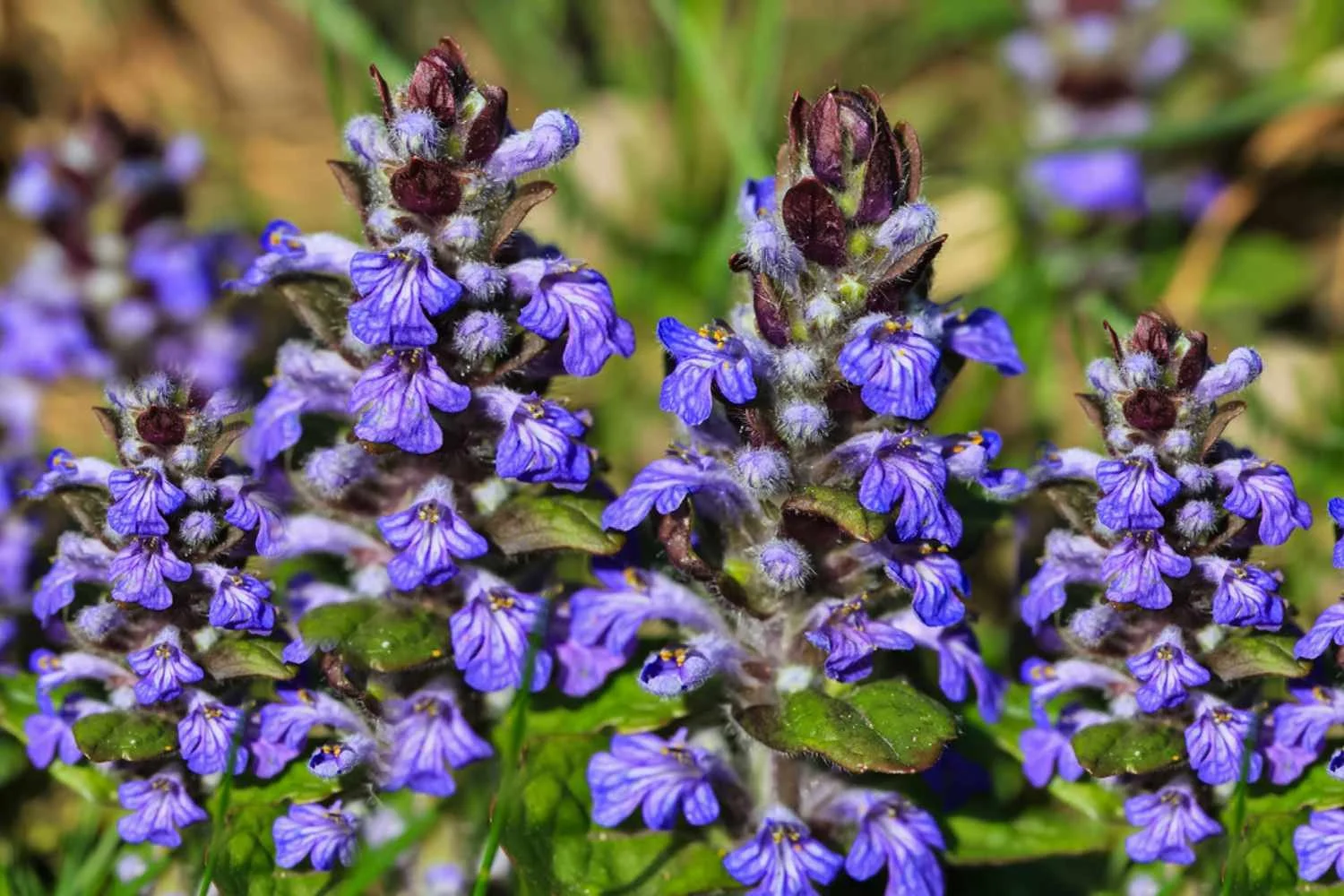
Bugleweed is a low-growing, mat-forming perennial that spreads quietly across the ground rather than rising upward. It is most recognisable in spring and early summer, when dense spikes of deep blue to violet flowers rise just above the leaves, creating pools of colour along woodland edges and damp grasslands.
The leaves are soft, oval and slightly glossy, often tinged with purple, especially in shaded or cooler conditions. Bugleweed spreads via creeping runners, rooting as it goes and forming interconnected patches that feel cohesive rather than invasive. Its presence is often noticed underfoot rather than at eye level.
Bugleweed has a modest appearance. It does not draw attention through height or fragrance, but through persistence and coverage. Once familiar, it becomes easy to recognise by its growth habit as much as its flowers.
Bugleweed typically appears as:
A low-growing, mat-forming perennial
Creeping runners that root along the ground
Soft, oval leaves, often dark green or purplish
Upright flower spikes bearing blue or violet flowers
Square stems typical of the mint family
It is most commonly confused with:
Decorative garden cultivars derived from wild ajuga
Other low-growing mint family plants
Lycopus species sometimes incorrectly called "bugleweed" in older texts
Correct identification is essential, particularly to distinguish Ajuga reptans from unrelated plants sharing the same common name.
Habitat, Growth & Ecology
Bugleweed is native to the UK and widespread across Europe. It thrives in damp, well-drained soils and is commonly found in woodland edges, hedgerows, shaded meadows and grasslands.
Ecologically, bugleweed functions as a stabilising groundcover. Its creeping growth helps retain moisture, reduce erosion and support soil structure. When in flower, it provides early nectar for pollinators, particularly bees.
Bugleweed returns reliably each year and spreads gradually rather than aggressively, contributing to ecosystem resilience without overwhelming surrounding plants.
History, Tradition & Cultural Use
Bugleweed has a long history in European folk herbalism, particularly in rural and monastic contexts. It was valued not for dramatic internal effects, but for its practicality and accessibility.
Historically, bugleweed was most often used externally. Old herbal texts describe it as a plant that "draws together" and "binds", language that reflects its traditional association with wound care and tissue support.
Bugleweed was commonly gathered fresh and used simply, reflecting its abundance and ease of access rather than rarity or prestige.
Myth, Lore & Symbolism
Bugleweed carries symbolic associations of humility and quiet repair. Its habit of growing close to the ground and spreading steadily rather than rising tall has linked it with persistence rather than dominance.
In folk understanding, bugleweed was a plant of mending - not dramatic healing, but gradual recovery. Its deep blue flowers, appearing early in the season, also associated it with renewal and protection during seasonal transition.
These meanings arise from relationship and observation rather than formal mythology.
Areas of Scientific Research Interest
Modern scientific interest in bugleweed has focused on its chemical composition and biological activity, primarily in laboratory and preclinical contexts. Research often examines Ajuga species more broadly rather than traditional preparations.
Bugleweed research remains exploratory and does not constitute clinical guidance.
Anti-inflammatory and Antioxidant Research
Studies suggest bugleweed contains flavonoids and phenolic acids that exhibit antioxidant and anti-inflammatory activity in vitro. These findings provide insight into its historical external use, particularly in relation to irritated or damaged tissue.
Antimicrobial Research
Laboratory studies have explored antimicrobial activity in extracts of Ajuga species. Results are context-specific and depend heavily on extraction method and concentration.
These findings help explain traditional applications but do not translate directly into real-world use.
Nutritional Profile: Vitamins & Minerals
Bugleweed is not used as a nutritional plant and does not contribute significantly to dietary intake.
Reported constituents of interest include:
Flavonoids - associated with antioxidant activity and tissue protection
Phenolic compounds - contribute to antimicrobial and inflammatory research
Bitter principles - influence traditional external applications
Its value lies in functional chemistry rather than nutrition.
Traditional Use vs Modern Research
Traditional use of bugleweed was shaped by practicality and observation. People used it where it grew, applied it externally and judged its usefulness by visible results rather than theory.
Modern research isolates compounds and examines their behaviour under controlled conditions. While this offers explanatory insight, it removes bugleweed from the everyday context in which it was historically used.
Where both frameworks align is in recognising bugleweed as supportive rather than forceful. Where they differ is in emphasis: tradition valued whole-plant simplicity, while research focuses on isolated activity.
Understanding bugleweed requires holding both perspectives without inflating either.
Preparation & Practical Use
Bugleweed has always been prepared simply. Its usefulness lies in freshness rather than processing, and in external application rather than internal consumption.
Preparation emphasised immediacy and gentleness rather than extraction.
External Preparations
Traditional and practical uses include:
Fresh poultices made from crushed leaves
Washes or infusions for external use
Inclusion in simple salves or ointments
These preparations were applied repeatedly rather than intensively, supporting gradual recovery.
Internal Use
Internal use of bugleweed has historically been limited and remains secondary. Modern herbal practice generally emphasises its external role.
Ethical Harvesting & Stewardship
Bugleweed is generally abundant, but responsible harvesting remains important.
Best practices include:
Harvesting small amounts from established patches
Avoiding uprooting whole plants
Leaving runners intact to allow regrowth
Harvesting away from polluted areas
As a groundcover species, bugleweed contributes to ecosystem stability and should be gathered thoughtfully.
Safety & Considerations
Bugleweed is generally considered safe when used externally.
Considerations include:
Accurate identification to avoid confusion with unrelated species
Moderation in any internal use
Awareness of individual sensitivities
Traditional use relied on familiarity and restraint rather than intensity.
How We Work With Bugleweed at KindRoots
At KindRoots, bugleweed is approached as a practical, locally familiar plant with a strong tradition of external use.
We work with bugleweed primarily in external preparations such as washes, poultices and simple skin applications, where its traditional role and gentle nature are most appropriate. It is used fresh where possible and processed minimally.
Our approach prioritises correct identification, modest quantities and everyday practicality, keeping bugleweed grounded in folk use rather than expanding it beyond its traditional role.
Ajuga reptans is used in our own practice and appears in a small number of our preparations.
Closing Note
Bugleweed does not ask to be noticed. It works close to the ground, quietly filling gaps and supporting recovery without display.
To work with bugleweed is to value persistence over spectacle. It reminds us that repair often happens slowly, underfoot, and through steady presence rather than force.
