
Old Man’s Beard ‘Usnea barbata’
Identification & Appearance
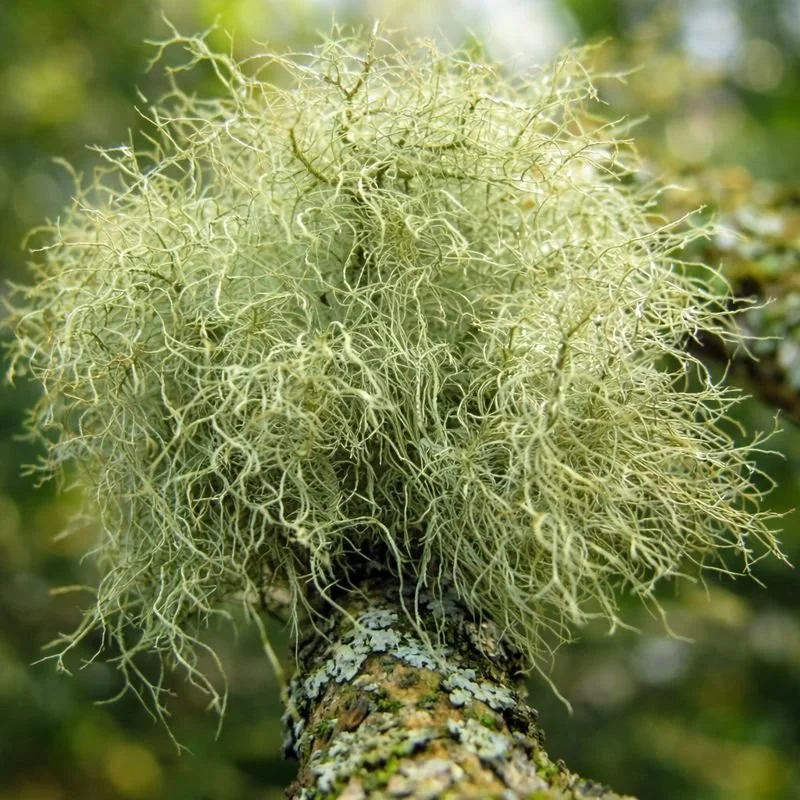
Usnea is not a plant and not a mushroom, but a lichen - a living partnership between a fungus and an alga. It appears as pale green, yellow-green or greyish strands hanging from tree branches in long, tangled threads, often mistaken for moss by those unfamiliar with it.
Its most important identifying feature is internal rather than external. When a strand of usnea is gently pulled apart, it reveals a fine, elastic white central cord running through the middle. This inner filament is the clearest way to distinguish true usnea from similar hanging lichens or debris caught in branches.
Usnea feels soft and wiry rather than leafy or brittle. It grows slowly and accumulates over many years, forming beards or tassels that sway with air movement. Its presence immediately signals clean air and undisturbed habitat.
Usnea typically appears as:
Pale green to yellow-green hanging strands
Branching, beard-like growth from trees
Soft, wiry texture
A visible white elastic core when pulled
Growth suspended rather than rooted
It is most commonly confused with:
Other beard lichens lacking an elastic core
Hanging mosses, which are true plants
Dead plant fibres caught in branches
The white inner filament is essential for correct identification.
Habitat, Growth & Ecology
Usnea species are native to the UK but are now far less common than historically. They grow on the bark and branches of trees, particularly in areas with clean air, high humidity and minimal pollution. Mature woodlands, upland forests and coastal environments with good air circulation provide ideal conditions.
Ecologically, usnea is an indicator species. Because it absorbs nutrients and moisture directly from the air, it is highly sensitive to pollution. Its presence reflects environmental health more than soil quality.
Usnea grows extremely slowly. Harvesting even small amounts can take years to recover, making ecological sensitivity central to any work with this lichen.
History, Tradition & Cultural Use
Usnea has been used across Europe, North America and parts of Asia in folk herbal and wilderness traditions. Historically, it was valued for reliability rather than rarity, often used where other materials were unavailable.
It appeared in both internal and external preparations, though external use was particularly common. Usnea was applied to wounds, used in washes and incorporated into salves. Internally, it was taken more cautiously, often as part of broader blends rather than alone.
Usnea’s use was practical and restrained. It was not consumed casually, but relied upon when conditions demanded it.
Myth, Lore & Symbolism
Usnea’s long, beard-like appearance has linked it symbolically with age, wisdom and endurance. In folklore, it became associated with forest elders, hermits and guardians - figures defined by patience rather than action.
Because usnea grows only where air is clean, it has also come to symbolise purity and protection. Its presence was read as a sign that the land was healthy enough to support subtle life.
These meanings arise from observation rather than mythic storytelling.
Areas of Scientific Research Interest
Modern scientific research into usnea has focused primarily on its chemical constituents, particularly usnic acid. Research is largely laboratory-based and examines isolated compounds rather than traditional whole-lichen preparations.
Usnea compounds are studied cautiously due to potency and toxicity concerns at high concentrations.
Antimicrobial Research
Studies suggest usnic acid exhibits antimicrobial activity in vitro against certain bacteria and fungi. This research helps explain historical external use, particularly in wound contexts.
However, laboratory results do not translate directly to traditional preparations or safe internal use.
Anti-inflammatory and Antioxidant Research
Some studies have explored usnea’s interaction with inflammatory pathways and oxidative stress at a cellular level. These findings remain preliminary and context-dependent.
Nutritional Profile: Vitamins & Minerals
Usnea is not used for nutrition and does not meaningfully contribute vitamins or minerals in the way food plants do.
Reported constituents of interest include:
Usnic acid - associated with antimicrobial research
Polysaccharides - contribute to immune-related research interest
Trace minerals - absorbed from air rather than soil
Its value lies in chemical activity rather than nutritional content.
Traditional Use vs Modern Research
Traditional use of usnea was shaped by restraint and context. People used it sparingly, often externally, and rarely in isolation. Effects were judged by outcome rather than explanation.
Modern research isolates usnic acid and studies it intensively, often at concentrations far removed from traditional use. This has led to both interest and concern, particularly regarding toxicity in isolated form.
Where the two frameworks diverge most strongly is dosage and preparation. Traditional use relied on whole material and moderation. Modern research focuses on isolated compounds.
Understanding usnea requires respecting these differences rather than collapsing one into the other.
Preparation & Practical Use
Usnea has always required careful preparation. Its slow growth and potent chemistry shaped cautious, minimal use rather than routine inclusion.
Preparation emphasised dilution, combination and external application.
Decoctions & Teas
Traditional internal preparations include:
Long, gentle decoctions using small amounts
Combination with other herbs rather than standalone use
These preparations were used briefly rather than continuously.
External Preparations
Usnea was more commonly used externally, including:
Washes for wounds
Poultices
Inclusion in salves and balms
External use aligns most closely with both tradition and safety.
Ethical Harvesting & Stewardship
Ethical harvesting of usnea is critical.
Responsible practice includes:
Harvesting only fallen material where possible
Never stripping lichens from living branches
Taking extremely small amounts
Harvesting only in clean, unpolluted environments
Leaving the vast majority untouched
Overharvesting can damage lichen populations for decades.
Safety & Considerations
Usnea requires particular caution.
Considerations include:
Avoiding concentrated or isolated usnic acid
Limiting internal use and duration
Prioritising external application
Awareness of documented toxicity at high doses
Traditional use relied on familiarity, dilution and moderation.
How We Work With Usnea at KindRoots
At KindRoots, usnea is treated as a sensitive, slow-growing lichen that demands restraint.
We work with usnea primarily in external preparations such as washes, balms and creams, where its traditional role and safety profile align most clearly. Internal use, where it occurs at all, is minimal and carefully contextualised within blends.
Our approach prioritises ethical sourcing, extreme moderation and respect for usnea’s ecological fragility, allowing it to remain a last-resort ally rather than a routine ingredient.
Usnea is used selectively in our own practice and appears in a small number of our preparations.
Closing Note
Usnea does not belong to abundance. It belongs to balance.
To work with usnea is to be reminded that usefulness is sometimes quiet and conditional. It teaches that some allies ask not to be harvested, but noticed, and that restraint can be as much a form of care as action.
