
Self-heal ‘Prunella vulgaris’
Identification & Appearance
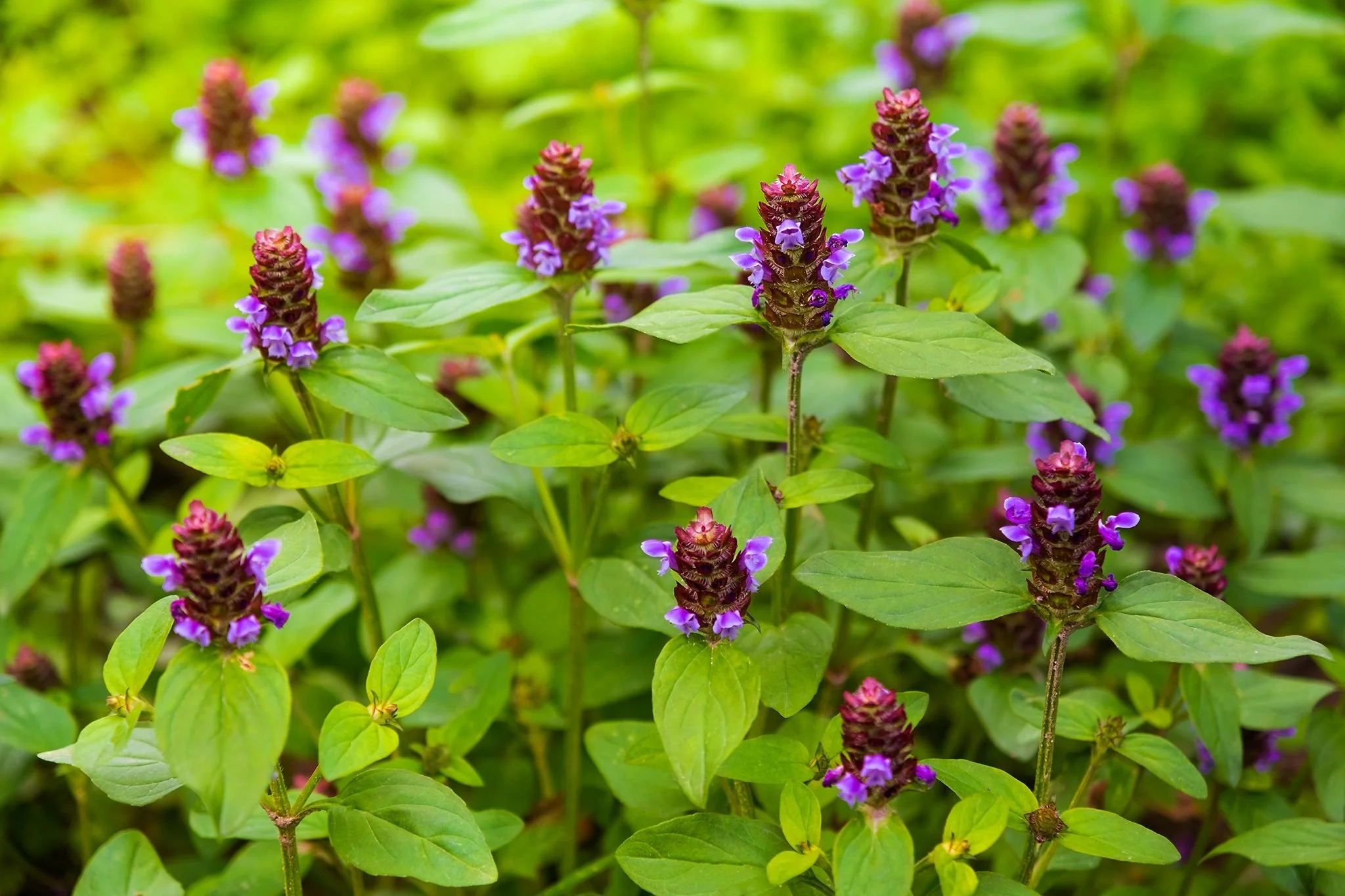
Self heal is a plant that rarely demands attention, yet rewards familiarity. Low-growing and spreading, it weaves itself through grassland, lawns and meadow edges, often overlooked until its deep purple flower spikes catch the eye. Its growth habit is calm and confident, forming mats rather than standing tall, suggesting steadiness rather than ambition.
The leaves are oval and softly toothed, held opposite one another on square stems typical of the mint family. Flowering spikes rise just above the leaves, densely packed with small, hooded purple flowers that bloom gradually from the base upward. The plant feels balanced and complete, as though it knows exactly how much space it needs.
Self heal typically appears as:
Low-growing, mat-forming perennial
Opposite oval leaves with soft toothed edges
Square stems
Dense purple flower spikes
Gradual flowering from base to tip
It is most commonly confused with:
Bugleweed (Ajuga reptans), which has glossier leaves and taller flower spikes
Other low-growing mint family plants
Flower structure and growth habit help distinguish it.
Habitat, Growth & Ecology
Self heal is native to the UK and widespread across Europe. It thrives in grasslands, lawns, meadow edges, woodland clearings and disturbed ground, adapting easily to both wild and human-shaped environments.
Ecologically, self heal is a stabilising groundcover plant. It supports pollinators during its long flowering period and tolerates mowing and grazing better than many flowering species. Its resilience has allowed it to persist in landscapes where other medicinal plants have disappeared.
Self heal reflects balance rather than dominance. It does not overtake ecosystems, but it endures quietly within them.
History, Tradition & Cultural Use
Self heal’s name reflects its reputation rather than a literal promise. Historically, it was regarded as a broadly supportive plant, particularly valued for external use and general recovery. It appears in European folk herbalism as a remedy for wounds, inflammation and sore throats, often used when healing felt slow or incomplete.
Traditionally, self heal was applied both externally and internally, though its strongest associations are with topical use. It was infused into washes for wounds, taken as a tea for throat irritation, and used as part of broader restorative routines rather than targeted treatment.
Self heal was not a dramatic herb. It earned trust through steady application and visible response over time.
Myth, Lore & Symbolism
Self heal carries little overt myth, but its name itself is symbolic. It reflects an older worldview in which testimony came from experience rather than explanation. The plant was named for what people observed, not for what it claimed to do.
In folk tradition, self heal became associated with self-reliance and quiet repair. Its presence in lawns and paths reinforced the idea that healing support could be close at hand, woven into everyday life rather than hidden in distant forests.
Areas of Scientific Research Interest
Modern scientific interest in self heal has focused on its anti-inflammatory, antioxidant and antimicrobial properties. Research often examines extracts and isolated compounds, exploring how they interact with inflammatory signalling and tissue environments.
Self heal appears in modern herbal products for throat support, skin care and immune-related formulations, reflecting continuity between traditional use and contemporary application.
Anti-inflammatory and Antioxidant Research
Studies suggest self heal contains compounds that:
Interact with inflammatory pathways
Support antioxidant activity
Contribute to tissue resilience
These findings help explain its long-standing use for wounds and irritation.
Antimicrobial Research
Laboratory research has explored self heal’s interaction with bacterial and viral models. Results suggest antimicrobial activity in controlled settings, particularly relevant to topical and throat-related applications.
Nutritional Profile: Vitamins & Minerals
Self heal is not consumed for nutrition, but it contains compounds that support general bodily function.
Reported constituents include:
Vitamin C - supports immune function and tissue repair
Vitamin K - supports normal blood clotting and tissue integrity
Calcium - supports bone health and cellular signalling
Magnesium - supports muscle function and nervous system regulation
Polyphenols - contribute to antioxidant activity
Tannins - support astringent and tissue-toning effects
Its value lies primarily in functional chemistry rather than nutritional density.
Traditional Use vs Modern Research
Traditional use of self heal was observational and practical. People noted that it supported closure, calming and repair, particularly where tissue was slow to respond. It was used repeatedly rather than intensively, often alongside other gentle herbs.
Modern research reframes these observations through molecular activity and inflammatory markers. While this helps explain potential mechanisms, it risks overstating precision. Traditional use did not isolate outcomes. It relied on visible improvement and comfort over time.
Where the two frameworks align is in recognising self heal as supportive rather than forceful. Where they diverge is in scale and expectation. Understanding self heal requires patience and context.
Preparation & Practical Use
Self heal has always been prepared simply. Its usefulness does not depend on concentration, but on regular, appropriate contact. Historically, it was worked with fresh when possible, or gently dried for later use.
Preparation methods emphasised accessibility and repetition rather than potency.
External Preparations
Common traditional uses include:
Washes for wounds and irritated skin
Compresses and poultices
Gargles for sore throats
These applications were often repeated over days rather than applied once.
Teas & Infusions
Self heal has also been prepared as:
Light teas for throat irritation
Gentle infusions used short-term
Internal use was supportive rather than long-term.
Ethical Harvesting & Stewardship
Self heal is generally abundant, but ethical harvesting remains important.
Responsible practice includes:
Harvesting aerial parts without uprooting plants
Taking small amounts from widespread patches
Avoiding overharvesting in frequently mown areas
Leaving enough flowering material for pollinators
Its resilience should encourage care, not neglect.
Safety & Considerations
Self heal is generally gentle and well tolerated.
Considerations include:
Accurate identification to avoid confusion with similar species
Moderation in internal use
Awareness that tannins may irritate sensitive digestion if overused
Traditional use emphasised familiarity, not intensity.
How We Work With Self Heal at KindRoots
At KindRoots, self heal is treated as a quiet restorative herb rather than a universal solution.
We work with self heal primarily in external preparations, washes and gentle teas, particularly where tissue support and calming are needed. It may also appear in blends aimed at throat comfort or slow recovery.
Our approach prioritises simplicity, appropriate quantity and repeated use, allowing self heal to work in the way it always has: steadily, without force.
Self heal is used thoughtfully in our own practice and appears in a limited number of our preparations.
Closing Note
Self heal does not rush the body. It waits with it. Its value lies not in dramatic change, but in creating the conditions where repair can finish what it has already begun.
To work with self heal is to accept that healing is often incremental and quiet. It reminds us that restoration does not always announce itself, and that patience, applied consistently, can be its own form of medicine.
