
Ribwort Plantain ‘Plantago lanceolata’
Identification & Appearance
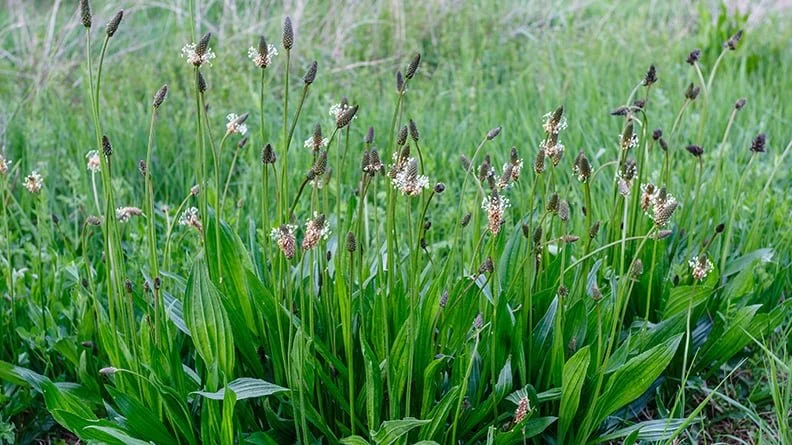
Ribwort plantain is a plant many people recognise without knowing its name. It grows close to the ground, unassuming and resilient, its narrow leaves rising in a basal rosette and marked by strong parallel ribs that give the plant its name. These ribs are immediately visible when the leaf is torn, revealing tough, fibrous strands that reflect the plant’s durability.
From the centre of the rosette rise slender, leafless stalks topped with compact brown seed heads, ringed by pale stamens when in flower. This contrast between the grounded leaves and upright flowering stems gives ribwort a distinctive silhouette, especially in grassland and paths.
Ribwort plantain typically appears as:
Narrow, lance-shaped leaves with prominent parallel ribs
Leaves forming a low basal rosette
Slender, upright flowering stalks
Brown cylindrical seed heads with pale stamens
Tough, fibrous leaf texture
It is most commonly confused with:
Broadleaf plantain, which has wider leaves
Young grasses, though grasses lack ribbed leaves
Leaf ribs remain the most reliable identifying feature.
Habitat, Growth & Ecology
Ribwort plantain is native to the UK and widespread across Europe. It thrives in grasslands, lawns, paths, pasture and compacted soils where many other plants struggle. Its ability to tolerate trampling, grazing and disturbance has made it one of the most enduring and familiar plants in human-shaped landscapes.
Ecologically, ribwort plantain plays an important role in stabilising soil and supporting insects, including pollinators and butterfly larvae. Its persistence reflects adaptation rather than dominance, making it a quiet indicator of resilient ground rather than fertile abundance.
History, Tradition & Cultural Use
Ribwort plantain has long been a plant of immediate usefulness. Historically, it was valued not as a tonic or ritual herb, but as a practical ally for everyday injuries and irritation. It appeared consistently in folk medicine across Britain and Europe, particularly in rural contexts where access to cultivated herbs was limited.
Traditionally, ribwort was used externally for cuts, stings, bites and abrasions. Leaves were crushed fresh and applied directly, often with little ceremony. Internally, it appeared in teas and syrups, particularly for coughs and respiratory irritation.
Ribwort belonged to the realm of the accessible. It was used because it was always there.
Myth, Lore & Symbolism
Ribwort plantain carries little myth in the dramatic sense, but it holds strong symbolic meaning through familiarity. Its presence along paths and thresholds has long associated it with protection during travel. In folk belief, plantain was considered a companion plant, one that followed human movement and offered support where feet passed repeatedly.
Its symbolism arises from endurance and service rather than spectacle. Ribwort was respected because it worked, quietly and consistently, wherever it was found.
Areas of Scientific Research Interest
Modern scientific interest in ribwort plantain has focused on its mucilage content, anti-inflammatory activity and interaction with respiratory and wound-healing pathways. Research examines both whole-leaf preparations and isolated compounds.
Ribwort extracts are used in modern herbal syrups, lozenges and topical products, reflecting a strong continuity between traditional and contemporary use.
Respiratory and Mucilage Research
Studies suggest ribwort plantain contains mucilage compounds that:
Soothe irritated mucous membranes
Support cough reflex moderation
Contribute to throat and upper respiratory comfort
These findings align closely with traditional use in coughs and chest irritation.
Wound and Anti-inflammatory Research
Research has explored ribwort’s interaction with inflammatory pathways and tissue repair environments. Results suggest supportive effects on skin and minor wound conditions, helping explain its historical use as a first-response leaf.
Nutritional Profile: Vitamins & Minerals
Ribwort plantain is not used primarily for nutrition, but it contains compounds that support general bodily function.
Reported constituents include:
Vitamin C - supports immune function and tissue repair
Calcium - supports bone health and muscle contraction
Potassium - supports fluid balance and normal muscle function
Silica - supports connective tissue strength and skin integrity
Mucilage - supports soothing interaction with mucous membranes
Tannins - contribute to astringent and tissue-toning effects
Its value lies primarily in functional plant chemistry rather than caloric contribution.
Traditional Use vs Modern Research
Traditional use of ribwort plantain was shaped by proximity and need. People used it because it was underfoot and effective. Effects were judged by outcome rather than explanation: bleeding slowed, irritation eased, coughing softened.
Modern research reframes these observations through biochemical lenses, identifying mucilage, tannins and anti-inflammatory compounds. While this explains mechanisms, it does not replace the contextual knowledge that governed traditional use, such as freshness, immediacy and simplicity.
Where the two frameworks align strongly is in ribwort’s role as a soothing, protective plant rather than a forceful intervention. Where they diverge is in scale: traditional use relied on fresh leaf and light preparations, while modern products often concentrate extracts.
Understanding ribwort requires keeping its everyday nature intact.
Preparation & Practical Use
Ribwort plantain has always been prepared simply. Its effectiveness relies less on extraction and more on direct contact and gentle preparation. Historically, people worked with what was immediately available rather than storing or processing extensively.
Preparation methods emphasised freshness, simplicity and repetition rather than strength.
External Preparations
Common traditional uses include:
Fresh leaf poultices for cuts, stings and bites
Crushed leaves applied directly to skin
Simple washes for irritated tissue
These uses relied on immediacy and were often applied repeatedly.
Teas, Syrups & Internal Use
Ribwort has also been prepared as:
Light teas for cough and throat irritation
Syrups combining ribwort with honey
Gentle infusions used short-term
Internal use was typically supportive rather than long-term.
Ethical Harvesting & Stewardship
Ribwort plantain is abundant, but ethical harvesting still matters.
Responsible practice includes:
Harvesting leaves without uprooting the plant
Taking small amounts from many plants
Avoiding polluted or heavily trafficked areas
Leaving enough growth for regeneration and wildlife
Its abundance invites care, not carelessness.
Safety & Considerations
Ribwort plantain is generally gentle and well tolerated.
Considerations include:
Accurate identification to avoid confusion with similar species
Moderation in internal use
Awareness that fresh leaves may cause mild irritation in sensitive individuals
Traditional use emphasised familiarity and repeated gentle application rather than intensity.
How We Work With Ribwort Plantain at KindRoots
At KindRoots, ribwort plantain is treated as a practical, grounding herb with deep roots in everyday folk use.
We work with ribwort primarily in teas, syrups and external preparations, particularly where soothing and protective qualities are needed. It is valued for its reliability and accessibility rather than potency.
Our approach prioritises fresh or gently dried leaf, simple preparation and respectful sourcing, allowing ribwort to function as it always has: as a steady, supportive presence rather than a dramatic remedy.
Ribwort plantain is used practically in our own practice and appears in a small number of our preparations.
Closing Note
Ribwort plantain reminds us that usefulness does not require rarity. It grows where pressure is constant, adapts to disturbance and offers support without asking to be noticed.
To work with ribwort is to recognise the value of what persists. It teaches that care can be immediate, local and quietly effective, and that some of the most reliable allies are those we walk past every day without realising they are there.
