
Oregano ‘Origanum vulgare’
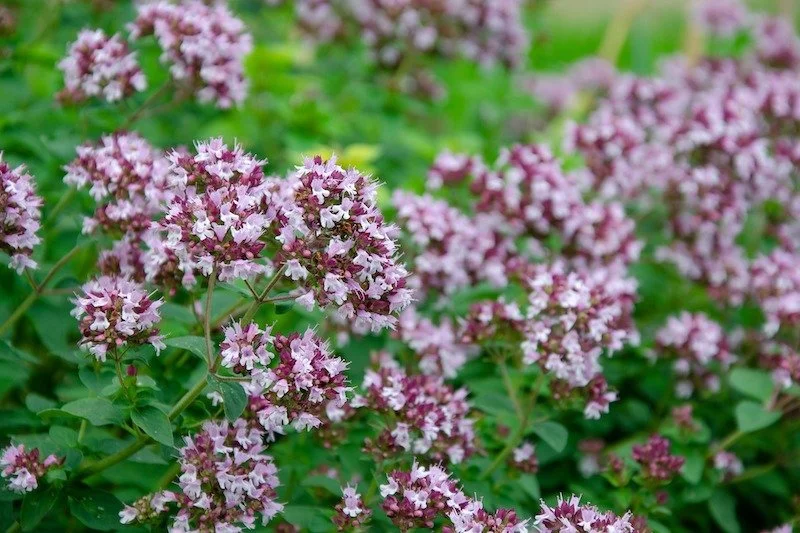
Identification & Appearance
Oregano is a plant that announces itself through scent before form. When brushed, crushed or warmed by sun, its leaves release a sharp, warm, unmistakably savoury aroma that signals strength and intensity. This sensory immediacy has always shaped how oregano is understood - as a plant that acts decisively and does not hide its nature.
The plant grows as a low, bushy perennial with woody stems at the base and soft, oval leaves arranged opposite each other along the stem. In summer, small clusters of pink, purple or pale white flowers appear, attracting pollinators and marking the plant’s peak potency. Compared to more delicate culinary herbs, oregano feels robust and concentrated.
Oregano typically appears as:
Small oval green leaves with smooth or lightly toothed edges
Strong, pungent aromatic scent when handled
Upright but bushy growth habit
Pink, purple or white flowers in summer
Woody lower stems on mature plants
It is most commonly confused with:
Marjoram, which is milder, sweeter and less pungent
Other aromatic mint family plants lacking oregano’s sharp intensity
Aroma remains the most reliable identifier.
Habitat, Growth & Ecology
Oregano is not native to the UK. It originates from the Mediterranean region and western Asia, where it thrives in dry, rocky soils and full sun. Despite this, it has been cultivated in the UK for centuries and is now well established in gardens, allotments and managed landscapes.
In suitable conditions, oregano is resilient and drought-tolerant, preferring well-drained soil and exposure. Ecologically, it supports pollinators during flowering and responds well to regular cutting, which encourages fresh growth and maintains potency.
As a cultivated herb in the UK, stewardship focuses on growing conditions, soil health and ethical sourcing rather than wild harvesting.
History, Tradition & Cultural Use
Oregano has a long and layered history across Mediterranean, Middle Eastern and European traditions. It has always occupied a dual role as both food and medicine, used daily rather than reserved for special occasions or illness.
Historically, oregano was valued for its strength. It was used to preserve foods, flavour heavy dishes and support digestion in warm climates where spoilage and stagnation were concerns. Oregano appeared in teas, infused oils and topical preparations, particularly where infection, dampness or heaviness were present.
Unlike gentler herbs, oregano was not used subtly. Its role was to assert clarity, movement and protection. It was chosen when something needed to be checked, shifted or cleared.
Myth, Lore & Symbolism
Oregano has long been associated with vitality and protection. In ancient traditions, it was linked with joy and strength, often used to crown newlyweds or planted near dwellings as a protective presence.
In domestic folklore, oregano’s strong scent and resilience gave it a reputation as a boundary plant - something that marked edges, discouraged stagnation and supported health through presence alone. These associations reflect lived experience with the plant rather than mythic storytelling.
Areas of Scientific Research Interest
Modern scientific interest in oregano has focused on its volatile oils and phenolic compounds, particularly carvacrol and thymol. Research examines how these compounds interact with microbial environments, inflammatory pathways and oxidative stress.
Oregano-derived compounds are already used in food preservation, animal health and pharmaceutical research. This reflects a clear through-line between traditional use and modern application, though laboratory research often examines concentrations far higher than those used traditionally.
Antimicrobial Research
Studies suggest oregano compounds may:
Inhibit growth of certain bacteria and fungi in laboratory settings
Interact with microbial cell membranes
Contribute to food preservation and shelf stability
These findings help explain oregano’s historical use in preservation and topical applications, but do not equate to standalone treatment.
Inflammatory and Antioxidant Research
Oregano has been studied for its interaction with inflammatory signalling and oxidative stress. Research suggests its compounds may support inflammatory balance and cellular protection when used appropriately and consistently.
Nutritional Profile: Vitamins & Minerals
Oregano contains a range of vitamins, minerals and plant compounds that contribute to its functional character, though it is typically used in small amounts.
Reported constituents include:
Vitamin K - supports normal blood clotting and bone health
Vitamin C - supports immune function and cellular repair
Calcium - supports bone strength and muscle contraction
Iron - supports oxygen transport and energy production
Magnesium - supports muscle function and nervous system regulation
Potassium - supports fluid balance and normal muscle function
Polyphenols - plant compounds associated with antioxidant activity
Volatile oils (including carvacrol and thymol) - contribute to aroma, antimicrobial research interest and traditional protective use
Traditional Use vs Modern Research
Traditional use of oregano was guided by sensory certainty. People knew when oregano was appropriate because its scent and taste made that clear. It was used where heaviness, spoilage or stagnation were present, and its effects were felt quickly and unmistakably.
Modern research reframes oregano through isolated compounds and antimicrobial metrics. While this explains part of its effectiveness, it can overemphasise potency without context. Traditional use rarely involved sustained high doses. Instead, oregano was used intermittently, in food or light preparations, as part of daily life.
Where both frameworks align is in recognising oregano as a strong plant. Where they diverge is in scale and intention. Traditional use balanced strength with restraint, while research often examines extremes.
Understanding oregano requires respecting both its power and its limits.
Preparation & Practical Use
Oregano has always been prepared in ways that emphasise release and concentration. Its volatile oils respond strongly to crushing, drying and extraction, which is why dried oregano often smells stronger than fresh.
Preparation choices traditionally reflected need. Light use in food supported digestion and preservation, while stronger preparations were reserved for short-term or external use.
Teas & Infusions
Common preparations include:
Light teas made from dried leaves
Short infusions rather than long decoctions
These are strong-tasting and typically taken in small amounts.
Oils & Culinary Use
Oregano is widely used:
As a culinary herb for daily digestive support
Infused into oils for topical or flavour use
Its presence in food has always been one of its safest and most consistent applications.
Oregano Oil
Oregano oil is produced by extracting and concentrating the plant’s volatile compounds, usually through steam distillation. This results in a preparation far stronger than whole-leaf use.
Because of this concentration, oregano oil is not equivalent to traditional food or tea preparations. Historically, oregano was worked with as a whole plant rather than as a highly concentrated oil.
In modern contexts, oregano oil is used in:
Encapsulated products
Highly diluted topical applications
Short-term, targeted formulations
Its potency means careful dilution and limited duration are essential. Oregano oil is best understood as a modern derivative rather than a continuation of traditional whole-plant use.
Ethical Harvesting & Stewardship
As oregano is a cultivated plant in the UK rather than a wild native, ethical considerations centre on how it is grown, harvested and processed, rather than protection of wild populations.
Responsible practice includes:
Growing oregano in well-drained, sun-exposed soil to support healthy oil production
Harvesting aerial parts without uprooting the plant, allowing it to regenerate
Cutting selectively rather than stripping entire plants
Harvesting during flowering or just before, when aromatic compounds are most concentrated
Because oregano responds well to regular cutting, thoughtful harvesting actually strengthens the plant over time. Stewardship here is about working with growth cycles, not extraction pressure.
When sourcing dried oregano or oregano oil, ethical stewardship also extends to supply chains. Concentrated products require large quantities of plant material, making transparency around cultivation, labour and processing especially important.
Safety & Considerations
Oregano is widely used as a food and is generally well tolerated in culinary amounts. However, its strength means context matters.
Considerations include:
Strong flavour and chemistry may irritate sensitive digestion when used in excess
Concentrated preparations, especially oregano oil, require careful dilution
Long-term high-dose use of concentrated extracts is not aligned with traditional practice
Topical use should always involve dilution to avoid skin irritation
Traditional use relied on whole plant preparations, moderate amounts and intermittent use rather than sustained intensity. Modern extracts and oils behave very differently and should not be treated as interchangeable with culinary oregano.
As with all aromatic herbs, quality, preparation method and quantity matter more than novelty or strength.
How We Work With Oregano at KindRoots
At KindRoots, oregano is treated as a plant of clarity and strength, used deliberately rather than routinely.
We work with oregano primarily in culinary contexts and tea blends, where its flavour supports digestion and its character brings lift and sharpness to heavier formulations. It may also appear in topical preparations in carefully balanced amounts.
We do not use oregano casually or in excess. Our approach prioritises moderation, appropriate form and respect for its potency, allowing oregano to do what it does best without overwhelming the system.
Oregano is used selectively in our own practice and appears in a small number of our preparations.
Closing Note
Oregano does not negotiate. It speaks clearly, smells strong and leaves no ambiguity about its presence. Its value lies in that honesty.
To work with oregano is to accept that some forms of support are meant to be decisive rather than gentle. It reminds us that clarity, when applied with restraint, can be protective rather than harsh - and that strength, when used well, does not need to linger to be effective.
