
Lion’s Mane ‘Hericium erinaceus’
Identification & Appearance
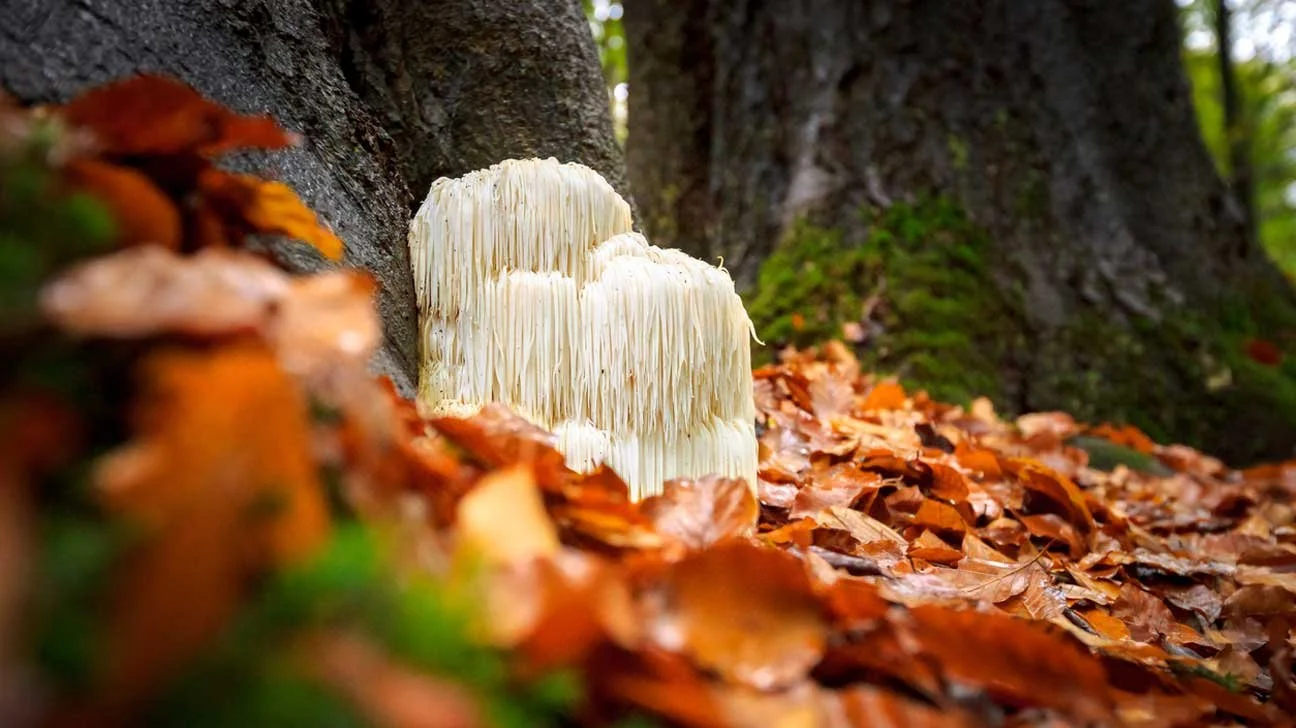
Lion’s Mane is one of the most distinctive fungi found in temperate forests. Rather than forming a cap, stem or gills, it appears as a single rounded mass covered in long, soft spines that cascade downward like icicles or hair. This unusual structure gives the mushroom its common name, evoking a white mane or beard suspended from wood.
Fresh specimens are white to cream in colour, becoming slightly yellowed with age. The texture is soft and fibrous when young, firming as it matures. Lion’s Mane grows as a solitary fruiting body or in small clusters, often protruding directly from the trunk or branches of hardwood trees.
Once familiar, Lion’s Mane is difficult to mistake for anything else. Its form stands apart from most woodland fungi, making visual identification relatively straightforward.
Lion’s Mane typically appears as:
A rounded white or cream-coloured mass
Long, hanging spines rather than gills or pores
Soft, fibrous texture when fresh
Growth directly from wood, without a stem
A clean, sculptural appearance
It is rarely confused with other species, though related Hericium species share similar features and are also considered edible.
Habitat, Growth & Ecology
Lion’s Mane is native to the UK, though it is relatively uncommon in the wild. It grows on hardwood trees, particularly beech and oak, favouring mature or aging woodland. It can appear on living trees, dead trunks or fallen branches.
Ecologically, Lion’s Mane plays a role in wood decomposition, breaking down lignin and cellulose and contributing to forest nutrient cycles. Because of its scarcity in some regions and increasing demand, cultivated Lion’s Mane now provides the primary source for most modern use.
Cultivation reduces pressure on wild populations while allowing consistent quality and availability.
History, Tradition & Cultural Use
Lion’s Mane has a long history of use in East Asia, particularly in China and Japan, where it was valued as both food and tonic. Rather than being used for acute conditions, it was traditionally consumed regularly as part of the diet.
In historical contexts, Lion’s Mane appeared in soups, broths and preserved preparations, often associated with mental clarity and longevity. Its use was steady rather than intensive, reflecting a broader philosophy of nourishment over correction.
In Europe, Lion’s Mane was historically less prominent, though modern interest has expanded rapidly alongside scientific research.
Myth, Lore & Symbolism
In East Asian traditions, Lion’s Mane became associated with composure, clarity and refinement. Its pristine white appearance and unusual form linked it symbolically with purity and disciplined thought.
Rather than featuring heavily in folklore stories, its symbolism developed through philosophy and practice. Lion’s Mane represented the cultivation of mind through steady nourishment rather than sudden insight.
Areas of Scientific Research Interest
Lion’s Mane is one of the most extensively researched medicinal mushrooms, particularly in relation to neurological health. Modern interest has focused on specific compounds found in both the fruiting body and mycelium.
Research includes laboratory, animal and a limited number of human studies, making Lion’s Mane relatively well characterised compared to many other fungi.
Neurological and Cognitive Research
Lion’s Mane contains compounds known as hericenones and erinacines, which have been studied for their interaction with nerve growth factor pathways.
Research suggests these compounds may:
Support nerve growth factor synthesis
Influence neuroplasticity
Contribute to cognitive function and memory
Human studies have examined Lion’s Mane in relation to mild cognitive impairment and age-related cognitive decline, with findings suggesting modest benefits during continued use.
Mood and Nervous System Research
Some research has explored Lion’s Mane’s interaction with mood and emotional wellbeing. Small human studies suggest potential effects on anxiety and mood balance, though results remain preliminary and context-dependent.
Nutritional Profile: Vitamins & Minerals
Lion’s Mane is nutritionally active as a food mushroom, contributing both macronutrients and bioactive compounds.
Reported constituents include:
B vitamins (B1, B2, B3) - support energy metabolism and nervous system function
Potassium - supports nerve signalling and muscle function
Zinc - supports immune function and cellular repair
Iron (trace) - supports oxygen transport
Beta-glucans - support immune modulation research
Polysaccharides - contribute to metabolic and neurological research interest
Its nutritional profile supports its role as a food-like mushroom rather than a concentrated supplement.
Traditional Use vs Modern Research
Traditional use of Lion’s Mane emphasised regular dietary inclusion. It was not taken sporadically or in high doses, but consumed consistently over time. Effects were understood as cumulative rather than immediate.
Modern research mirrors this emphasis on consistency. Studies suggest benefits diminish when use stops, reinforcing the idea that Lion’s Mane supports ongoing processes rather than producing lasting changes after short exposure.
Where the two frameworks align strongly is in recognising Lion’s Mane as a long-term ally. Where they diverge is in preparation. Traditional use relied on whole mushroom consumption, while modern research often isolates specific compounds.
Preparation & Practical Use
Lion’s Mane has always been prepared in ways that preserve its structure and compounds. As a soft-bodied fungus, it lends itself well to cooking and gentle extraction.
Preparation emphasised regular inclusion rather than intensity.
Culinary Use
Traditional and modern preparations include:
Sautéed or roasted fruiting bodies
Inclusion in soups and broths
Dried and powdered forms added to foods
Culinary use remains one of the most traditional ways to work with Lion’s Mane.
Teas, Decoctions & Extracts
Lion’s Mane is also prepared as:
Teas and light decoctions
Tinctures and dual extracts
These forms are typically used consistently rather than intermittently.
Ethical Harvesting & Stewardship
Because Lion’s Mane is uncommon in the wild, ethical considerations are especially important.
Responsible practice includes:
Prioritising cultivated sources
Avoiding unnecessary wild harvesting
Supporting growers using clean substrates
Leaving wild specimens untouched where possible
Cultivation protects forest ecosystems while meeting demand.
Safety & Considerations
Lion’s Mane is generally well tolerated as both food and supplement.
Considerations include:
Individual sensitivities
Gradual introduction for new users
Awareness that benefits require consistency rather than high doses
Quality and preparation method significantly influence outcomes.
How We Work With Lion’s Mane at KindRoots
At KindRoots, Lion’s Mane is approached as a food-like mushroom rather than a quick intervention.
We work with Lion’s Mane primarily in culinary forms and gentle extracts, valuing its suitability for regular, sustained use. It may also appear in blends where cognitive support and nervous system nourishment are appropriate.
Our approach prioritises cultivated sources, consistent preparation and long-term relationship, reflecting both traditional dietary use and modern research findings.
Lion’s Mane is approached as a food-like mushroom in our own practice and appears in several of our preparations.
Closing Note
Lion’s Mane does not promise sudden clarity. It offers something quieter: the conditions for attention to deepen over time.
To work with Lion’s Mane is to commit to continuity rather than intensity. It reminds us that the nervous system responds best not to force, but to steady nourishment applied patiently, day after day.
