
Cleavers ‘Galium aparine’
Identification & Appearance
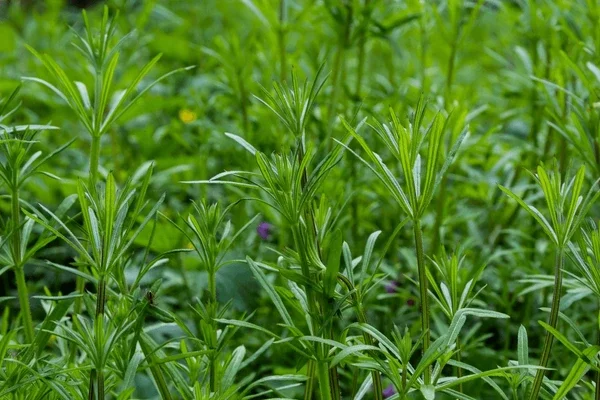
Cleavers is a plant that announces itself through touch rather than sight. Its long, scrambling stems cling to anything they encounter, catching on clothing, fur and neighbouring plants with small hooked hairs that give it a persistent, adhesive quality. Once noticed, it becomes unmistakable.
The plant grows in loose, sprawling tangles, its thin square stems lined with whorls of narrow leaves, usually six to eight per node. Both stems and leaves are covered in tiny backward-facing hooks that allow cleavers to climb, sprawl and anchor itself without structural strength. Small white, four-petalled flowers appear in spring and early summer, followed by paired round seeds that cling just as readily.
Cleavers typically appears as:
Long, weak, scrambling stems that cling to surfaces
Narrow leaves arranged in whorls around the stem
Fine hooked hairs covering stems and leaves
Small white four-petalled flowers
Paired round seed pods that stick to clothing and fur
It is most commonly confused with:
Other bedstraw species, which are usually less sticky
Young hedge plants before leaf structure is noticed
The clingy texture is the most reliable identifying feature.
Habitat, Growth & Ecology
Cleavers is native to the UK and widespread across Europe. It thrives in hedgerows, woodland edges, disturbed ground, gardens and shaded paths, particularly where soil is rich in nitrogen.
Ecologically, cleavers is an opportunist. It grows quickly, using surrounding plants for support rather than competing for height or strength. Its presence reflects fertility and disturbance rather than neglect, often appearing where human activity has shaped the land.
Cleavers completes its life cycle rapidly, dying back as summer progresses. Its abundance is seasonal and self-limiting rather than permanent.
History, Tradition & Cultural Use
Cleavers has long been used in European folk herbalism as a spring plant, gathered when growth is lush and tender. Traditionally, it was valued as a cleansing and moving herb, used to support the body’s eliminative systems after winter stagnation.
Historically, cleavers was used both internally and externally. It appeared in fresh juices, teas and light infusions, as well as washes and compresses for swollen or irritated tissue. Its use emphasised flow, drainage and gentle stimulation rather than force.
Cleavers was rarely dried for long-term storage. Its role was immediate and seasonal.
Myth, Lore & Symbolism
Cleavers carries symbolism rooted in contact and connection. Its tendency to cling has linked it with ideas of attachment and movement, a plant that travels by sticking close rather than standing apart.
In folk tradition, cleavers was associated with clearing what was stuck or congested. Its physical behaviour became metaphor: a plant that grabs hold in order to move things along. These interpretations reflect lived experience rather than mythic narrative.
Areas of Scientific Research Interest
Modern scientific interest in cleavers has focused on its interaction with lymphatic, urinary and inflammatory pathways. Research often examines aqueous extracts and whole-plant preparations rather than isolated compounds.
Cleavers is included in modern herbal formulations aimed at fluid movement and tissue drainage, reflecting continuity with traditional use.
Lymphatic and Fluid Regulation Research
Studies suggest cleavers may:
Support lymphatic circulation
Influence fluid movement within tissues
Interact with mild oedematous conditions
These findings align with traditional use for swelling and congestion.
Anti-inflammatory Research
Laboratory studies indicate cleavers contains compounds that interact with inflammatory pathways, supporting its historical use in soothing irritated or swollen tissue.
Nutritional Profile: Vitamins & Minerals
Cleavers is not used primarily for nutrition, but it contains constituents that support bodily function, particularly when used fresh.
Reported constituents include:
Vitamin C - supports immune function and connective tissue health
Calcium - supports bone health and cellular signalling
Potassium - supports fluid balance and normal muscle function
Magnesium - supports nervous system regulation
Silica - supports connective tissue strength and skin integrity
Iridoid glycosides - contribute to anti-inflammatory research interest
Its value lies in functional support rather than caloric contribution.
Traditional Use vs Modern Research
Traditional use of cleavers was shaped by timing and texture. It was gathered young, used fresh and applied where movement was needed. Effects were judged by changes in swelling, comfort and circulation rather than named outcomes.
Modern research seeks to explain these effects through lymphatic and inflammatory pathways. While this provides useful context, it risks overstating precision. Traditional use was responsive and observational, not diagnostic.
Where both frameworks align is in recognising cleavers as a gentle mover rather than a stimulant. Where they diverge is in application. Cleavers was never intended for long-term, year-round use.
Preparation & Practical Use
Cleavers has always been prepared lightly. Its tender nature and water-soluble constituents favour fresh, minimal processing rather than heavy extraction.
Preparation emphasised immediacy, freshness and repetition.
Teas, Juices & Infusions
Common traditional preparations include:
Fresh plant teas and infusions
Light decoctions used briefly
Juices or blended fresh preparations
These forms preserve cleavers’ cooling, moving character.
External Preparations
Cleavers has also been used in:
Washes for swollen or irritated tissue
Compresses applied repeatedly
External use reflects its traditional role in supporting circulation and drainage.
Ethical Harvesting & Stewardship
Cleavers is abundant, but responsible harvesting still matters.
Responsible practice includes:
Harvesting young, tender growth
Taking small amounts from widespread patches
Avoiding uprooting entire plants
Harvesting away from polluted areas
Its rapid growth allows for sustainable use when gathered thoughtfully.
Safety & Considerations
Cleavers is generally gentle and well tolerated.
Considerations include:
Fresh use preferred over long-term dried storage
Moderation in extended internal use
Awareness that its diuretic nature may not suit all individuals
Traditional use emphasised short-term, seasonal application.
How We Work With Cleavers at KindRoots
At KindRoots, cleavers is treated as a seasonal, moving herb rather than a daily tonic.
We work with cleavers primarily in fresh teas, light infusions and washes, particularly during spring when gentle support for circulation and fluid movement is appropriate. It may also appear in blends where soft drainage and cooling qualities are needed.
Our approach prioritises freshness, simplicity and seasonality, allowing cleavers to do what it has always done best: support flow without force.
Cleavers are used gently and over time in our own practice and appear in a small number of our preparations.
Closing Note
Cleavers does not stand still. It moves by contact, by persistence and by proximity.
To work with cleavers is to recognise that congestion often softens through gentle movement rather than pressure. It reminds us that progress does not always come from pushing forward, but from loosening what is already there and allowing the body to carry itself onward.
