
Chaga Mushroom: The Questions People Keep Asking
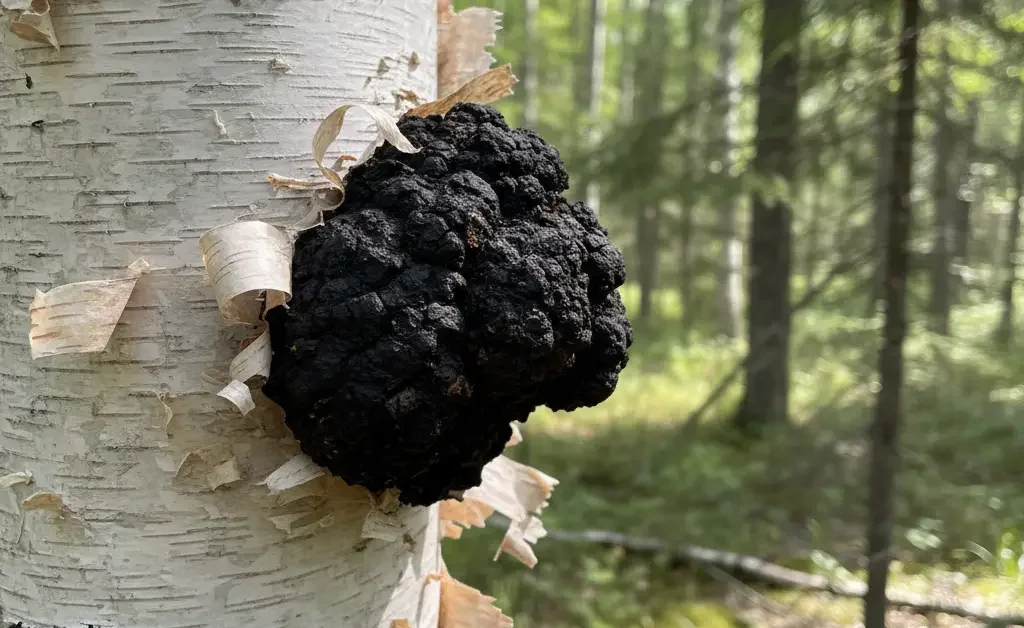
Chaga is one of the mushrooms people tend to ask about once they’ve already encountered it in some form — a dark tea, a chunk someone has been simmering for years, or a product that looks nothing like what they expected a mushroom to be.
The questions are rarely abstract. They’re practical, and they come up again and again. Is it safe to take regularly? What does it actually do? Why does everyone make such a big deal about it being wild? And increasingly, is it something that’s going to become “an issue” in the UK, the way other medicinal mushrooms have?
This post isn’t an introduction to Chaga as a species — that’s covered elsewhere. It’s here to answer the questions people tend to ask once they’re already curious, and trying to work out how Chaga fits into real life rather than internet narratives.
What Chaga actually is — and what it isn’t
Chaga doesn’t behave like most mushrooms, and a lot of the confusion starts there. It isn’t a soft fruiting body that appears and disappears with the seasons. It grows slowly, over many years, as a dense mass on living birch trees.
Because of that, people often misinterpret it. Some assume it’s a tree growth rather than a fungus. Others assume it must be a modern discovery because it doesn’t look familiar. In reality, Chaga has been worked with for a long time across northern regions, usually as a slow-simmered decoction taken regularly rather than occasionally.
That context matters, because Chaga isn’t something traditionally used for quick or dramatic effects. It was valued precisely because it could be taken over long periods without forcing the body in any particular direction.
What people usually mean when they ask “what does Chaga do?”
When someone asks this, they’re often expecting a short, outcome-based answer. Chaga doesn’t really lend itself to that.
It isn’t stimulating, and it isn’t sedating. People don’t usually feel an immediate “kick” from it. Traditionally, it’s been used as a general support — something that sits in the background, taken daily or near-daily, rather than something you reach for when something is already wrong.
That’s also why some people dismiss it early on. If you’re expecting a noticeable effect in the first few days, Chaga can seem underwhelming. It makes more sense when you think in terms of long-term support rather than short-term intervention.
Can Chaga be taken every day?
This is one of the most common questions, and it’s a sensible one.
In traditional contexts, Chaga was often taken daily, usually as a weak decoction made from whole material and simmered for a long time. The emphasis was on consistency rather than strength.
Where things get more complicated is with modern formats. Powders, extracts and highly concentrated products don’t always reflect the way Chaga was historically used, even if they come from the same organism. Taking something occasionally at a high strength isn’t the same as taking something gently and regularly.
As with most slow, traditional materials, moderation tends to matter more than intensity. Chaga isn’t something that benefits from being pushed hard.
What does Chaga taste like?
Chaga doesn’t taste like what most people expect.
It isn’t savoury or “mushroomy”. A well-prepared Chaga tea is dark and earthy, with a bitterness that’s closer to coffee or roasted roots than to herbal tea. Some people notice faint vanilla or woody notes, particularly with longer simmering times.
The flavour can be an adjustment at first, but it tends to soften the longer it’s prepared. That slow preparation isn’t just tradition — it materially changes both the taste and the experience of drinking it.
Why wild Chaga is treated differently
This is where a lot of misunderstanding creeps in.
Wild Chaga grows extremely slowly, sometimes over decades, on living birch trees. During that time, it draws compounds from the tree itself. That long relationship is part of why wild Chaga develops the profile it’s known for.
Most commercial “Chaga” products on the market aren’t made from this material. They’re made from cultivated mycelium grown on grain in controlled conditions. That’s a different material, produced on a completely different timescale.
They’re related, but they’re not the same. When people talk about traditional Chaga use, they’re talking about the slow-grown, wild material — not something designed to be produced quickly and at scale.
That difference matters, both ecologically and practically.
Is Chaga legal in the UK?
Chaga itself hasn’t suddenly become illegal. It grows wild, it’s native to northern regions, and it isn’t forbidden to identify or forage responsibly.
Where people get caught out is around commercial sale. As with other medicinal mushrooms, issues tend to arise when Chaga is processed into concentrated forms, standardised products, or marketed with specific health claims.
UK and EU food law isn’t particularly well-suited to traditional materials that sit somewhere between food and medicine. Once something starts to look like a supplement rather than a food-like material, the regulatory expectations change.
For most people preparing Chaga at home in traditional ways, this never becomes relevant. The confusion tends to come from watching what happens in commercial markets and assuming it applies universally.
Why Chaga attracts so much attention
Chaga sits at a strange intersection. It has a long history of use, it grows in an unusual way, and it’s been the subject of increasing scientific interest. That combination tends to invite strong claims, and strong claims tend to invite scrutiny.
When something is marketed as a solution rather than a support, attention follows quickly. That’s not unique to Chaga — it’s a pattern that repeats whenever slow, traditional materials are pushed into fast, modern frameworks.
Our perspective
We’ve always found Chaga easiest to work with when it’s treated as what it is: a slow material, suited to slow routines.
It isn’t dramatic, and it isn’t urgent. It doesn’t make much sense when it’s framed as a fix or a shortcut. Where it does make sense is in consistency — small amounts, taken regularly, without expectation of immediate results.
That approach tends to align better with both the material itself and the traditions it comes from.
If you’re looking for Chaga prepared in this slower, whole-material way, we keep our current Chaga products here.
Going deeper
If you’re looking for details on identification, growth patterns, or traditional preparation methods, those are covered in our Forager’s Guide.
This post exists to answer the questions that usually come after someone has already encountered Chaga and is trying to decide how — or whether — it belongs in their life.
Closing note
Chaga doesn’t reward impatience.
It grows slowly, it’s prepared slowly, and it tends to work best when it’s approached in the same way. Once you strip away the noise and the claims, it’s still just a dense, dark fungus doing what it’s always done — growing quietly, over time, in relationship with the trees around it.
That context matters more than any headline ever could.
