
Rosehips ‘Rosa spp’
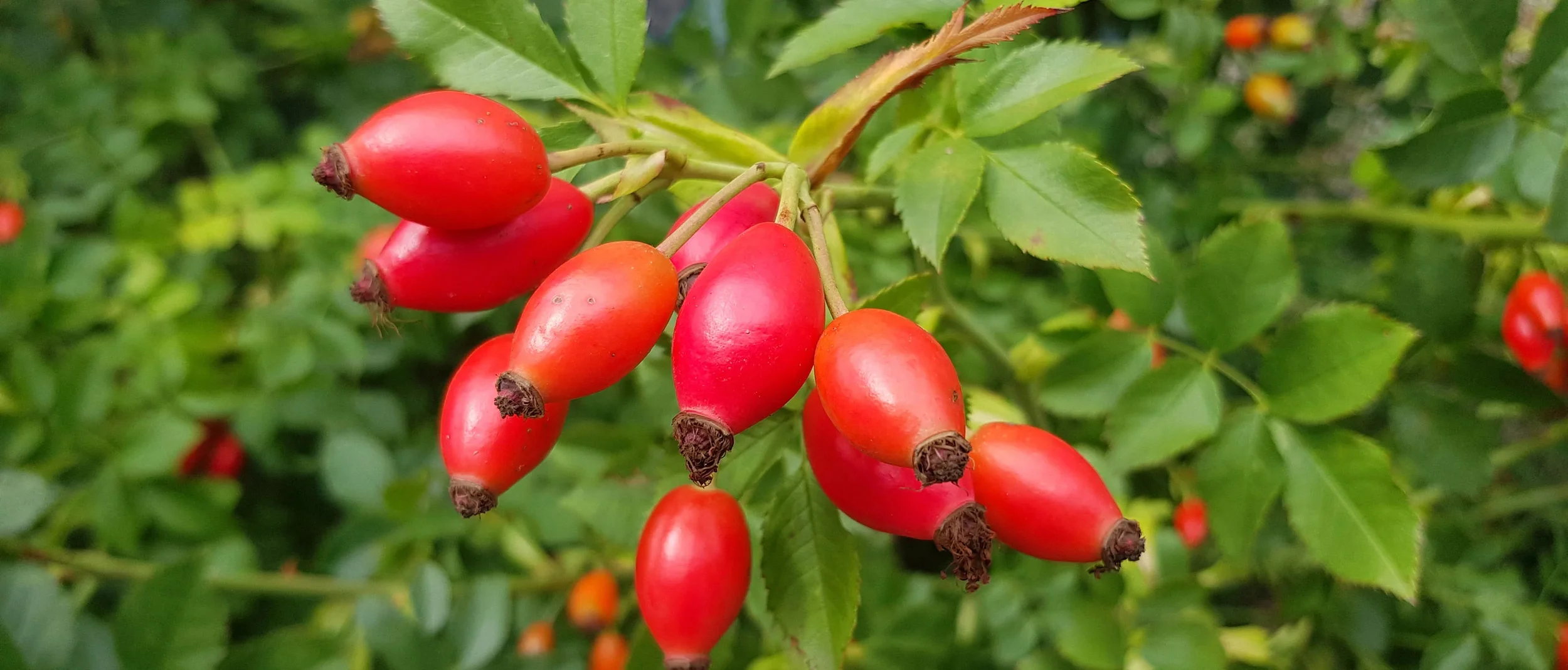
Identification & Appearance
Rose hips are the fruit of wild and cultivated roses, forming after the flower has bloomed and dropped its petals. Where roses announce themselves briefly through colour and scent, rose hips develop slowly and quietly, swelling over weeks as the season turns. Their presence marks a shift from display to substance - from attraction to storage.
The hips vary in shape depending on species, from round and apple-like to elongated and oval. Their skins are smooth and taut when ripe, usually deep red or orange, enclosing dense flesh and a cluster of seeds surrounded by fine irritating hairs. This combination of nourishment and irritation has always shaped how rose hips are handled and prepared.
Rose hips typically appear as:
Red to orange fruit forming after flowering
Smooth, glossy or slightly matte skin
Rounded or elongated shape depending on species
Firm, fleshy outer layer when ripe
Persistent sepals at the tip in many wild species
They are most commonly confused with:
Hawthorn berries, which are smaller and mealy and lack internal hairs
Rowan berries, which grow in clusters and do not contain irritating fibres
Correct identification matters, particularly when harvesting from mixed hedgerows.
Habitat, Growth & Ecology
Many wild roses, including dog rose, are native to the UK and widespread across hedgerows, woodland margins and field edges. Rose hips develop wherever roses are allowed to grow freely, often thriving in poor soils, exposed ground and transitional landscapes shaped by grazing and human movement.
Ecologically, rose hips play an important role as a winter food source for birds and mammals. Their tendency to remain on the plant well into colder months reflects the rose’s strategy of delayed nourishment, offering sustenance when softer fruits are no longer available. Ethical harvesting means taking modest amounts and leaving plenty behind, particularly in harsh winters.
History, Tradition & Cultural Use
Rose hips have long been gathered as a seasonal food rather than a specialised medicine. Historically, they were valued during autumn and winter when fresh fruit was scarce, and their role was shaped by necessity rather than theory. They belonged to the everyday economy of hedgerow and household, not to elite or specialist practice.
Across Europe, rose hips were prepared as syrups, teas, preserves and soups. During periods of hardship, particularly in wartime Britain, rose hip syrup became an important source of nourishment for children, reinforcing their reputation as a sustaining food rather than a corrective remedy.
Rose hips were gathered in quantity, processed carefully, and relied upon for continuity through colder months. Their use was practical, repetitive and rooted in long-term resilience rather than immediate effect.
Myth, Lore & Symbolism
Roses carry heavy symbolic weight, but rose hips occupy a quieter, more grounded place within that story. Where the rose flower has long represented beauty, desire and transience, the hip represents what remains after display has passed.
In folk understanding, rose hips were associated with protection and endurance. Their persistence through frost and snow lent them meaning as guardians of nourishment, holding value through the leanest months. They were not objects of ceremony, but of trust - respected for what they quietly provided when little else remained.
Areas of Scientific Research Interest
Modern scientific interest in rose hips has developed primarily from their long-standing role as a nutritional support rather than from dramatic medicinal claims. Research has focused on vitamin content, antioxidant compounds and interactions with inflammatory pathways, particularly in the context of long-term use.
Rose hip powders and extracts are now used in modern nutritional supplements and functional foods. This represents a continuation of traditional use in contemporary form, though much research examines concentrated preparations rather than whole-fruit use, which affects how findings should be interpreted.
Vitamin and Antioxidant Research
Studies suggest rose hips contain compounds that:
Support antioxidant activity in the body
Contribute to connective tissue maintenance
Help protect cells from oxidative stress
These findings align with historical use as a strengthening, sustaining food rather than an acute intervention.
Joint and Inflammatory Research
Some studies have explored rose hip preparations in relation to inflammatory processes and joint comfort. Results suggest supportive effects over time with consistent use, though outcomes vary depending on preparation method, dosage and study design.
Nutritional Profile: Vitamins & Minerals
Rose hips are notably nutrient-dense compared to many wild fruits.
Reported constituents include:
Vitamin C - supports immune function, collagen formation and tissue repair
Vitamin A (carotenoids) - supports skin integrity and mucous membrane health
Vitamin E - contributes to cellular protection against oxidative stress
Polyphenols - plant compounds associated with antioxidant activity
This nutritional profile helps explain why rose hips were historically relied upon during periods of scarcity and illness.
Traditional Use vs Modern Research
Traditional use of rose hips was shaped by nourishment rather than intervention. People did not consume rose hips to target specific symptoms; they consumed them to strengthen the body through sustained intake over time. Effects were understood through seasonal resilience, not immediate change.
Modern research approaches rose hips by isolating compounds and measuring outcomes under controlled conditions. This helps clarify mechanisms but can obscure the original context, where rose hips functioned as food first and remedy second.
Where the two frameworks align is in recognising the importance of consistency and long-term use. Where they diverge is in intention. Traditional use aimed to maintain resilience and prevent depletion, while modern research often seeks measurable therapeutic outcomes.
Understanding rose hips requires holding both perspectives without collapsing one into the other.
Preparation & Practical Use
Rose hips were traditionally prepared with care and restraint. Their internal hairs are irritating to skin and mucous membranes, shaping preparation methods that prioritised removal, dilution or long simmering. This influenced both how they were handled and how often they were used.
Preparation methods were designed to make rose hips safe, nourishing and shelf-stable, allowing their value to extend through winter months when fresh foods were unavailable.
Teas, Syrups & Preserves
Common preparations include:
Long-simmered decoctions, strained carefully
Syrups and cordials used sparingly but regularly
Jams, pastes and fruit leathers
Preparation emphasises slow extraction and gentle heat rather than raw consumption.
Ethical Harvesting & Stewardship
Rose hips develop slowly and remain on the plant well into autumn and winter, providing an important food source for birds and mammals during scarce months. Ethical harvesting therefore requires restraint and awareness of timing.
Responsible practice includes:
Harvesting modest amounts from many plants rather than stripping a single bush
Leaving a significant proportion of hips on each plant for wildlife
Avoiding harvesting during harsh winters when food is scarce
Gathering from clean hedgerows away from traffic and pollution
Rose hips should never be treated as an unlimited resource. Their value lies as much in what they provide to ecosystems as in what they offer people.
Safety & Considerations
Rose hips are widely used as food, but preparation matters.
Considerations include:
Fine hairs inside the hip can irritate skin and mucous membranes if not removed or well strained
Whole or poorly prepared hips may cause throat or digestive irritation
Moderate, consistent use is more appropriate than large quantities
Traditional preparation methods evolved specifically to make rose hips safe and nourishing. Skipping these steps undermines both safety and effectiveness.
How We Work With Rose Hips at KindRoots
At KindRoots, rose hips are treated as a seasonal nourishing fruit rather than a targeted supplement. We work with them in ways that reflect their traditional role as a source of resilience and continuity.
Rose hips are most often used in teas, syrups and blended preparations, where their nutritional contribution supports the body steadily over time. We prioritise careful preparation, thorough straining and moderate use, respecting both their benefits and their physical properties.
Our approach emphasises patience and consistency, allowing rose hips to function as they always have - as nourishment that strengthens quietly rather than medicine that acts forcefully.
Rose hips are used seasonally in our own practice and appear in a limited number of our seasonal preparations.
Closing Note
Rose hips teach us that value does not always arrive at the height of beauty. They come after the flower has fallen, developing slowly as attention moves elsewhere. Their gift is not immediacy, but endurance.
In a world drawn to quick results and visible change, rose hips offer a different lesson. They remind us that resilience is built through accumulation, care and timing - and that what sustains us most deeply often arrives when the spectacle has already passed.
