
Red Clover ‘Trifolium pratense’
Identification & Appearance
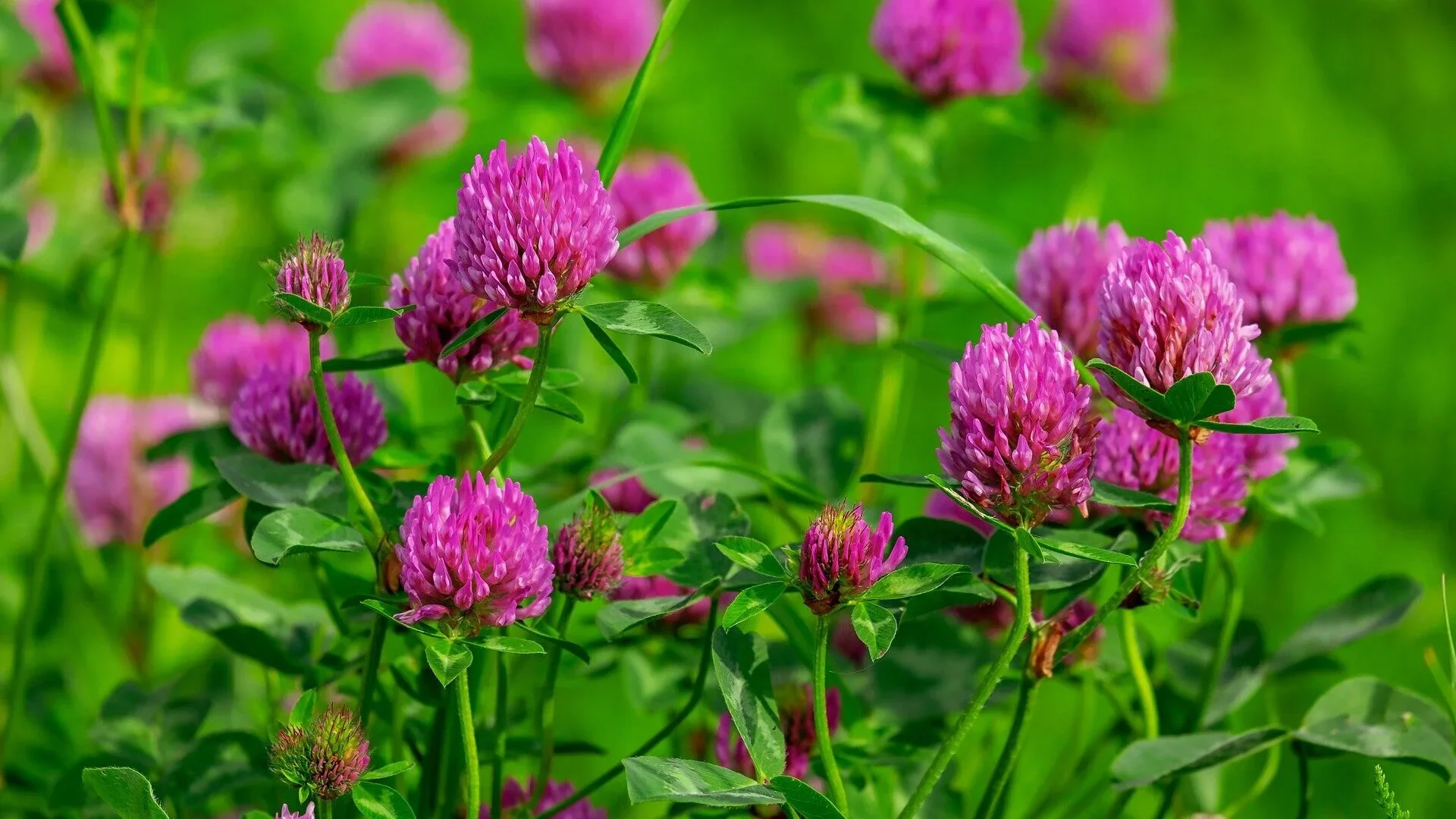
Red clover is a familiar and quietly generous plant, common enough to be overlooked yet distinctive once attention is paid. It grows low to the ground, sending up soft, hollow stems topped with rounded flower heads made up of many small tubular blossoms. The flowers range from pale pink to deep rosy-purple, often paling as they age.
The leaves are trifoliate, each leaflet marked with a pale crescent or chevron. The overall impression is softness rather than structure. Red clover does not assert itself through height or strength, but through abundance, appearing in meadows, verges and grasslands as a collective rather than as individual plants.
Its presence often signals soil that is alive and balanced, shaped by grazing, movement and seasonal rhythm.
Red clover typically appears as:
Rounded pink or reddish-purple flower heads
Trifoliate leaves with pale chevron markings
Soft, slightly hairy stems
Low-growing, spreading habit
Abundant growth in open grasslands
It is most commonly confused with:
White clover (Trifolium repens), which has white flowers and creeping stems
Alsike clover, which has paler flowers and different growth patterns
Correct identification is straightforward once flower colour and growth habit are noted.
Habitat, Growth & Ecology
Red clover is native to the UK and widespread across Europe. It thrives in meadows, pastureland, roadside verges and open grasslands, particularly where soil is moderately fertile and regularly disturbed by grazing or mowing.
Ecologically, red clover plays an important role as a nitrogen-fixing plant. Through its relationship with soil bacteria, it enriches the soil, supporting surrounding plant communities and improving long-term fertility. Its flowers are a key nectar source for bees and other pollinators, particularly long-tongued species.
Red clover is short-lived as a perennial, often behaving more like a biennial. Its abundance relies on reseeding and healthy land management rather than persistence of individual plants.
History, Tradition & Cultural Use
Red clover has a long history in European folk medicine, where it was associated with cleansing, nourishment and balance. It was traditionally gathered in flower and used in teas, syrups and simple preparations, often taken over extended periods.
Historically, red clover was valued as a gentle, supportive plant rather than a forceful remedy. It was often used as part of spring or seasonal routines, associated with clearing stagnation and supporting recovery after winter.
In domestic herbal practice, red clover occupied a space between food and medicine. It was familiar, accessible and safe enough to be used regularly, particularly for women’s health and long-term constitutional support.
Myth, Lore & Symbolism
Clover carries deep symbolic weight across Europe, associated with luck, protection and harmony. Red clover, with its softer colour and rounded form, became linked with ideas of gentleness, renewal and emotional steadiness.
Its three-part leaves have long been interpreted symbolically, representing balance and wholeness. In folk tradition, clover was often associated with thresholds - growing where wild and cultivated land meet, and symbolising transition rather than destination.
Red clover’s symbolism reflects its practical role: a plant of quiet restoration rather than dramatic change.
Areas of Scientific Research Interest
Modern scientific interest in red clover has focused largely on its isoflavone content and its interaction with hormonal pathways. Research includes laboratory studies, observational research and a number of human trials, particularly in relation to menopausal health.
Importantly, research tends to focus on extracted or standardised preparations rather than traditional whole-flower teas, which affects how findings should be interpreted.
Hormonal and Menopausal Research
Red clover contains isoflavones, plant compounds that can interact with estrogen receptors.
Research has examined red clover in relation to:
Menopausal symptoms such as hot flushes
Bone density and long-term skeletal health
Cardiovascular markers associated with estrogen decline
Findings are mixed, with some studies showing modest benefits and others showing minimal effect. Variability is linked to preparation method, individual metabolism and baseline hormonal status.
Antioxidant and Inflammatory Research
Red clover has also been studied for antioxidant activity, largely due to its flavonoid and phenolic content. Laboratory studies suggest these compounds may influence oxidative stress pathways, though clinical relevance remains context-dependent.
Nutritional Profile: Vitamins & Minerals
Red clover is not consumed for nutritional density, but it does contain compounds that support long-term physiological balance.
Reported constituents include:
Isoflavones - associated with hormonal modulation and menopausal research
Flavonoids - support antioxidant activity and tissue protection
Vitamin C (trace) - supports connective tissue and immune resilience
Calcium (trace) - supports bone structure and muscle function
Magnesium (trace) - supports nervous system function and energy metabolism
Its value lies in functional chemistry rather than vitamin concentration.
Traditional Use vs Modern Research
Traditional use of red clover emphasised gentleness and duration. It was often taken as a daily tea over weeks or months, with effects understood as gradual rather than immediate. People did not expect quick results, but steady improvement in overall balance.
Modern research attempts to quantify specific outcomes, particularly around menopausal symptoms. While this has generated useful insight, it can narrow perception of red clover’s broader traditional role as a nourishing, systemic ally.
Where both frameworks align is in recognising red clover as suitable for longer-term use rather than acute intervention. Where they differ is in expectation of measurable endpoints versus lived experience.
Preparation & Practical Use
Red clover is traditionally worked with in gentle forms that reflect its soft chemistry. Preparation focuses on regular intake rather than concentrated extraction.
Teas & Infusions
Traditional use centres on:
Light infusions of dried flower heads
Daily or near-daily consumption over time
These teas are mild, slightly sweet and easy to drink, reinforcing red clover’s role as a long-term companion plant.
Tinctures & Extracts
Red clover is also prepared as:
Alcohol tinctures
Standardised extracts in modern contexts
These forms are often used where consistency or specific dosing is required.
Ethical Harvesting & Stewardship
Red clover is abundant, but responsible harvesting still matters.
Best practice includes:
Harvesting only open, healthy flowers
Leaving plenty for pollinators
Avoiding harvesting in heavily polluted areas
Taking small amounts from many plants rather than stripping patches
Red clover’s ecological role as a pollinator plant makes restraint essential.
Safety & Considerations
Red clover is generally considered safe, but context matters.
Considerations include:
Caution in hormone-sensitive conditions
Awareness of interactions with hormone-modulating medications
Preference for moderate, consistent use rather than high-dose extracts
Traditional use relied on whole-plant preparations rather than concentrated isolates.
How We Work With Red Clover at KindRoots
At KindRoots, red clover is treated as a gentle, long-term ally rather than a targeted intervention.
We work with red clover primarily in teas and supportive blends, where its nourishing, balancing qualities can unfold gradually. It is often chosen for women’s health formulations and seasonal support, where consistency matters more than intensity.
Our approach prioritises whole-flower preparations, ethical harvesting and patience, allowing red clover to work as it always has: quietly, steadily and in relationship with the body’s own rhythms.
Red clover is used gently in our own practice and appears in a limited number of our preparations.
Closing Note
Red clover does not rush the body toward change. It accompanies it.
To work with red clover is to accept that balance often emerges slowly, through repetition and care rather than force. It reminds us that restoration is not always dramatic - sometimes it arrives softly, through familiarity, trust and time.
